Hygieostatic Bat Roost

Why it's listed
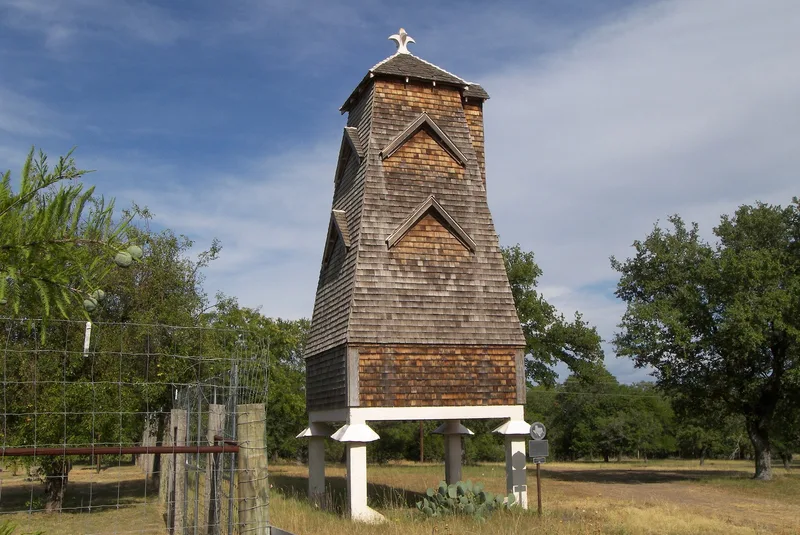
Rising about 30 feet on a raised concrete platform east of Comfort, Texas, this shingled pyramidal tower was built in 1918 as a home for bats. Its form echoes the cupolas of late Victorian buildings, with a louvered dormer for bat access, false dormers, a finial and a wooden guano hopper inside. Albert Steves, a former San Antonio mayor, commissioned it on his family's ranch using plans by San Antonio physician Charles A. R. Campbell, who believed colonies of bats could reduce mosquitoes and the spread of malaria. Campbell's earlier experiments included a roost at Mitchell Lake, where malaria was widespread. Only 16 such roosts are reported to have been built in the United States and Italy between 1907 and 1929. This one appears to be the last survivor of seven built in Texas and the oldest of three known in the country. It remains in good condition, still hosts bats, and has only tin rodent guards added to its original form.
Significance in brief: It is an architectural rarity built in an experimental attempt to control malaria naturally. Only 16 such roosts are reported to have been built in the U.S. and Italy between 1907 and 1929. It is apparently the last survivor of seven Texas roosts and the oldest of three known surviving roosts in the nation.
Machine-generated summary. This summary was generated by a language model from the official nomination document and has not been reviewed line by line by an editor. It may contain errors. Check the source document before relying on any detail. Source: nomination document (PDF) · National Archives catalog entry. NRHP reference 83003144, listed March 28, 1983. Summary generated October 2026 (model claude-sonnet-5-5, prompt v1.0-2026-10-29, confidence high).
Key facts
| Address | E of Comfort, Comfort |
|---|---|
| County | Kendall County |
| Listed | March 28, 1983 |
| Reference number | 83003144 |
| Resource type | Structure |
| Period of significance | 1900- |
| Architect / builder | Charles A. R. Campbell |
| Architectural style | Shingle style influence; modelled on the Victorian cupola form |
| Areas of significance | Health/Medicine, Science, Architecture |
| Level of significance | Local |
| Status (as stated in the nomination) | Described as in near-perfect, well-maintained condition, with the only alteration being tin rodent guards, and still inhabited by bats. |
| Acreage | 0.9 |
| Coordinates | 29.97088, -98.88640 (NPS GIS) |
What listing means for this property
National Register listing is honorary: it recognises significance and does not restrict what a private owner may do without federal money or permits. It unlocks the 20% federal rehabilitation tax credit for income-producing buildings, state credits in many states, and Section 106 review when federal agencies are involved. See what listing means in practice.
General information, not legal or tax advice. Rules change; confirm with your State Historic Preservation Office or a qualified adviser.
Sources and further reading
- National Park Service, National Register of Historic Places database (snapshot May 2026), reference 83003144.
- Nomination form (PDF, National Archives) — catalog entry
- Wikipedia article (used for cross-checking only; text not reproduced here)
- Wikidata Q18207937
- This listing as JSON
Last updated October 2026. Found an error? See the editorial policy for how to report it.