Panna Maria Historic District

Why it's listed
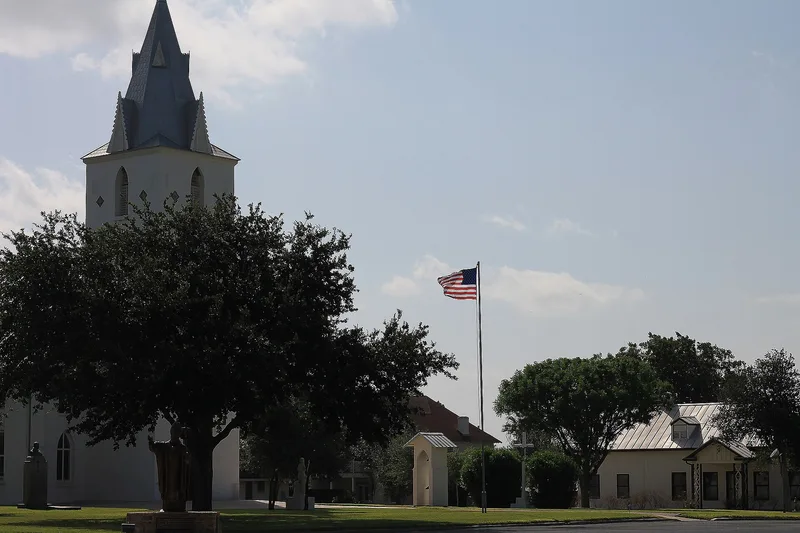
Panna Maria is a small farming community in the rolling hills of Karnes County, Texas, about 55 miles southeast of San Antonio. Polish immigrants from Upper Silesia founded it in 1854 on a plateau above the San Antonio River and Cibolo Creek. The district covers the village center and farm dwellings west along FM 81. Its focal point is St. Mary's Church, a Gothic Revival stuccoed stone building of 1877 with a 100-foot tower. Nearby are the 1868 St. Joseph's School, a rectory, early stores and steep-roofed stone cottages modeled on Silesian peasant houses. Long, narrow farm strips running toward the water still show the central European land pattern. The settlement is considered the oldest Polish colony in the United States, and it has the oldest Polish Catholic parish and the oldest Polish school in the country. It also served as the mother colony for other Silesian Polish settlements in Texas. Many buildings remain in use, while a few stand as ruins.
Significance in brief: Panna Maria is described as the oldest Polish colony in the United States, with the oldest Polish Catholic parish and the oldest Polish school in America. It also served as the mother colony of the Silesian Polish settlements in Texas. The 1854 immigration is called the first organized Polish peasant immigration to the United States.
Machine-generated summary. This summary was generated by a language model from the official nomination document and has not been reviewed line by line by an editor. It may contain errors. Check the source document before relying on any detail. Source: nomination document (PDF) · National Archives catalog entry. NRHP reference 76002043, listed May 13, 1976. Summary generated October 2026 (model claude-sonnet-5-5, prompt v1.0-2026-10-29, confidence medium).
Key facts
| Address | TX 123, Panna Maria and |
|---|---|
| County | Karnes County |
| Listed | May 13, 1976 |
| Reference number | 76002043 |
| Resource type | District |
| Period of significance | 1800-1899 (specific date 1854) |
| Architectural style | Polish colonial stone cottages; Gothic Revival church (St. Mary's, 1877) |
| Areas of significance | Entertainment/Recreation, Exploration/Settlement, Architecture, Social History |
| Level of significance | National, State |
| Status (as stated in the nomination) | Mixed use: many 19th-century buildings are still in use as homes, a church, rectory, museum, guest houses or barns, a few are ruins, and some houses are unoccupied. |
| Acreage | 2400 |
| Coordinates | 28.94616, -97.91730 (NPS GIS) |
What listing means for this property
This is a historic district. Buildings within its boundary are either contributing (they add to the district's significance) or non-contributing. Owners of contributing income-producing buildings can claim the 20% federal rehabilitation tax credit; homeowners should look at state credits. National Register districts impose no design review by themselves; a local historic district ordinance, if one exists, does (the difference explained).
General information, not legal or tax advice. Rules change; confirm with your State Historic Preservation Office or a qualified adviser.
Sources and further reading
- National Park Service, National Register of Historic Places database (snapshot May 2026), reference 76002043.
- Nomination form (PDF, National Archives) — catalog entry
- Wikidata Q109999728
- This listing as JSON
Last updated October 2026. Found an error? See the editorial policy for how to report it.