Pound, Dr. Joseph M. and Sarah, Farmstead

Why it's listed
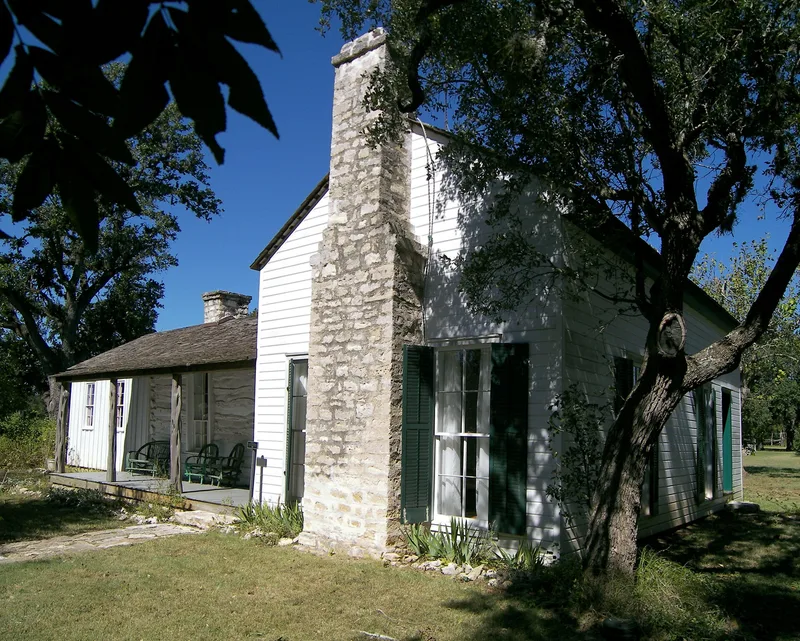
Founders' Park in Dripping Springs occupies the remnant of a farmstead established about 1854 by Dr. Joseph M. and Sarah Pound, who came from Mississippi with a group of settlers. Their house began as two cypress log pens joined by an open dogtrot. Over four generations it gained frame additions, a dining room, a kitchen and enclosed porches, and one original log pen survives. Nearby stand a limestone smokehouse, a windmill with stone reservoir and trough, a corral, a double crib barn, an outhouse and a stone-walled hot frame. The property is described as the last of the town's original farmsteads. Dr. Pound practiced medicine from the house and helped found the Dripping Springs Baptist Academy in 1880. The site also holds archeological potential, including the location of a cabin that housed enslaved people. Vacant since 1987, the property is being stabilized for use as a museum.
Significance in brief: The nomination calls it the last of Dripping Springs' original farmsteads, reflecting rural life from the 1850s to the early 20th century. It is tied to Dr. Pound, an early settler who helped found the community's Baptist Academy. Archeological deposits may also hold information on frontier medicine, farm life and enslaved African Americans.
Machine-generated summary. This summary was generated by a language model from the official nomination document and has not been reviewed line by line by an editor. It may contain errors. Check the source document before relying on any detail. Source: nomination document (PDF) · National Archives catalog entry. NRHP reference 95000929, listed July 28, 1995. Summary generated October 2026 (model claude-sonnet-5-5, prompt v1.0-2026-10-29, confidence high).
Key facts
| Address | Ranch Rd. 12 N., Dripping Springs |
|---|---|
| County | Hays County |
| Listed | July 28, 1995 |
| Reference number | 95000929 |
| Resource type | Building |
| Period of significance | c.1854-1914 |
| Architect / builder | unknown |
| Architectural style | No Style |
| Criteria |
|
| Areas of significance | Agriculture, Exploration/Settlement, Historic - Non-Aboriginal |
| Level of significance | Local |
| Status (as stated in the nomination) | Vacant since a 1987 bequest to the City of Dripping Springs and deteriorated; a nonprofit foundation acquired it in 1992, stabilization is underway, and it is planned for museum use. |
| Acreage | 3 |
| Coordinates | 30.20071, -98.08088 (NPS GIS) |
What listing means for this property
National Register listing is honorary for a privately owned home: it does not by itself restrict what an owner may do with their own money, and it does not require public access. Restrictions come from local landmark or historic-district ordinances, which are separate (how they differ).
Owner-occupied houses are not eligible for the 20% federal rehabilitation tax credit, which applies to income-producing buildings, but many states offer credits for homeowners. Listing also opens the door to preservation easements and to buying a plaque. Start with what listing means for homeowners, renovating a listed house and selling one.
Noted as vacant in the nomination. Nomination documents can be decades old; current status may differ. If you are considering buying an empty listed property, read the due-diligence checklist.
General information, not legal or tax advice. Rules change; confirm with your State Historic Preservation Office or a qualified adviser.
Sources and further reading
- National Park Service, National Register of Historic Places database (snapshot May 2026), reference 95000929.
- Nomination form (PDF, National Archives) — catalog entry
- Wikipedia article (used for cross-checking only; text not reproduced here)
- Wikidata Q5304216
- This listing as JSON
Last updated October 2026. Found an error? See the editorial policy for how to report it.