Braches House

Why it's listed
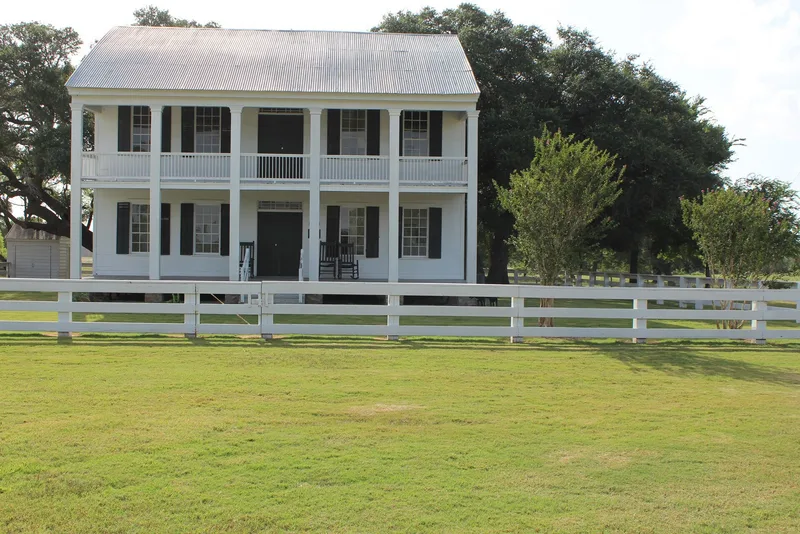
Twelve miles southeast of Gonzales stands a large Greek Revival plantation house that also served as a stage stop. Built between 1839 and 1842 by Bart McClure, an early Texas pioneer and first county judge of Gonzales County, it was constructed during the years of the Republic of Texas. Its two-story front gallery, with square columns, an entablature and stick balusters, was unusually advanced for inland Texas. After McClure died in 1842, his widow married Charles Braches, a Prussian immigrant who represented Gonzales County in the Seventh Congress of the Republic and later became known for gifts to schools and churches. In front of the house grows a live oak marked by the state as the place where Sam Houston, in March 1836, learned of the fall of the Alamo and ordered Fannin to retreat from Goliad, an episode tied to the Runaway Scrape. The house has lost its end chimneys and original front doors but retains its basic form.
Significance in brief: The house was built while Texas was an independent republic, and its full two-story Greek Revival gallery was advanced for inland Texas at the time. A large live oak in front, known as the Sam Houston Oak or Runaway Speech Oak, is tied to Sam Houston's 1836 orders during the Runaway Scrape. The house is also linked to McClure and Charles Braches, a Republic of Texas congressman and philanthropist.
Machine-generated summary. This summary was generated by a language model from the official nomination document and has not been reviewed line by line by an editor. It may contain errors. Check the source document before relying on any detail. Source: nomination document (PDF) · National Archives catalog entry. NRHP reference 71000936, listed March 11, 1971. Summary generated October 2026 (model claude-sonnet-5-5, prompt v1.0-2026-10-29, confidence medium).
Key facts
| Address | 12 mi. SE of Gonzales off U.S. 90A, Gonzales |
|---|---|
| County | Gonzales County |
| Listed | March 11, 1971 |
| Reference number | 71000936 |
| Resource type | Building |
| Period of significance | 1836, 1839-42 (19th century) |
| Architect / builder | Bart McClure (builder) |
| Architectural style | Greek Revival |
| Areas of significance | Politics/Government, Architecture, Social History |
| Level of significance | State |
| Status (as stated in the nomination) | Described as in fair condition, occupied as a private residence, with preservation work in progress; the owner was believed to plan restoration. |
| Acreage | 2 |
| Coordinates | 29.47608, -97.30926 (NPS GIS) |
What listing means for this property
National Register listing is honorary for a privately owned home: it does not by itself restrict what an owner may do with their own money, and it does not require public access. Restrictions come from local landmark or historic-district ordinances, which are separate (how they differ).
Owner-occupied houses are not eligible for the 20% federal rehabilitation tax credit, which applies to income-producing buildings, but many states offer credits for homeowners. Listing also opens the door to preservation easements and to buying a plaque. Start with what listing means for homeowners, renovating a listed house and selling one.
General information, not legal or tax advice. Rules change; confirm with your State Historic Preservation Office or a qualified adviser.
Sources and further reading
- National Park Service, National Register of Historic Places database (snapshot May 2026), reference 71000936.
- Nomination form (PDF, National Archives) — catalog entry
- Wikidata Q110002077
- This listing as JSON
Last updated October 2026. Found an error? See the editorial policy for how to report it.