Roberts, Dr. Rufus A., House

Why it's listed
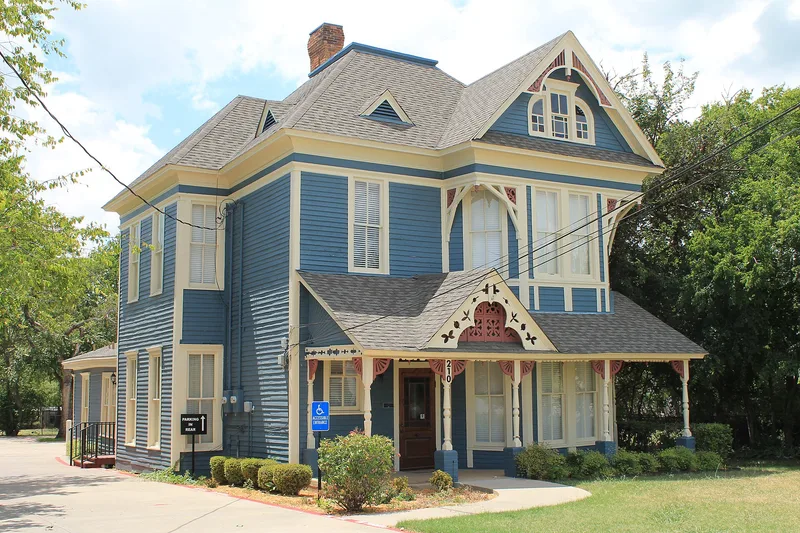
Built around 1884 at 210 South Broad Street in Cedar Hill, this two-story wood-framed house is described as the oldest and most architecturally ornate house in the city. It has cypress lap siding, a one-story rear wing, a mansard roof originally topped with a widow's walk, and two-over-two double-hung windows with simple drip molds. A two-story front bay window gives it its Stick Style character. The gable carries locally crafted bargeboard and a Palladian window with art glass, and the shed-roofed porch has turned posts on brick piers with sunburst brackets. Structural evidence suggests the bay window was added after the house was built and the porch was remodeled later, probably shortly after 1900. The house belonged to Dr. Rufus A. Roberts, who came to Cedar Hill in 1859, served in the Civil War, then practiced medicine and opened a drug store. He helped bring the railroad to town and kept practicing until about 1900, when he passed the practice to his son. The property sits on a .35 acre tract.
Significance in brief: The nomination calls it the most architecturally ornate house in Cedar Hill and the oldest in the city. It is a Stick Style example tied to Dr. Roberts, an early leading citizen who practiced medicine, opened a drug store and helped bring the railroad to town.
Machine-generated summary. This summary was generated by a language model from the official nomination document and has not been reviewed line by line by an editor. It may contain errors. Check the source document before relying on any detail. Source: nomination document (PDF) · National Archives catalog entry. NRHP reference 85000713, listed March 27, 1985. Summary generated October 2026 (model claude-sonnet-5-5, prompt v1.0-2026-10-29, confidence medium).
Key facts
| Address | 210 S. Broad St., Cedar Hill |
|---|---|
| County | Dallas County |
| Listed | March 27, 1985 |
| Reference number | 85000713 |
| Resource type | Building |
| Architectural style | Victorian-era Stick Style |
| Areas of significance | Commerce, Architecture |
| Level of significance | Local |
| Acreage | 0.9 |
| Coordinates | 32.58808, -96.95741 (NPS GIS) |
What listing means for this property
National Register listing is honorary for a privately owned home: it does not by itself restrict what an owner may do with their own money, and it does not require public access. Restrictions come from local landmark or historic-district ordinances, which are separate (how they differ).
Owner-occupied houses are not eligible for the 20% federal rehabilitation tax credit, which applies to income-producing buildings, but many states offer credits for homeowners. Listing also opens the door to preservation easements and to buying a plaque. Start with what listing means for homeowners, renovating a listed house and selling one.
General information, not legal or tax advice. Rules change; confirm with your State Historic Preservation Office or a qualified adviser.
Sources and further reading
- National Park Service, National Register of Historic Places database (snapshot May 2026), reference 85000713.
- Nomination form (PDF, National Archives) — catalog entry
- Wikidata Q110001822
- This listing as JSON
Last updated October 2026. Found an error? See the editorial policy for how to report it.