Daniels Farm House

Why it's listed
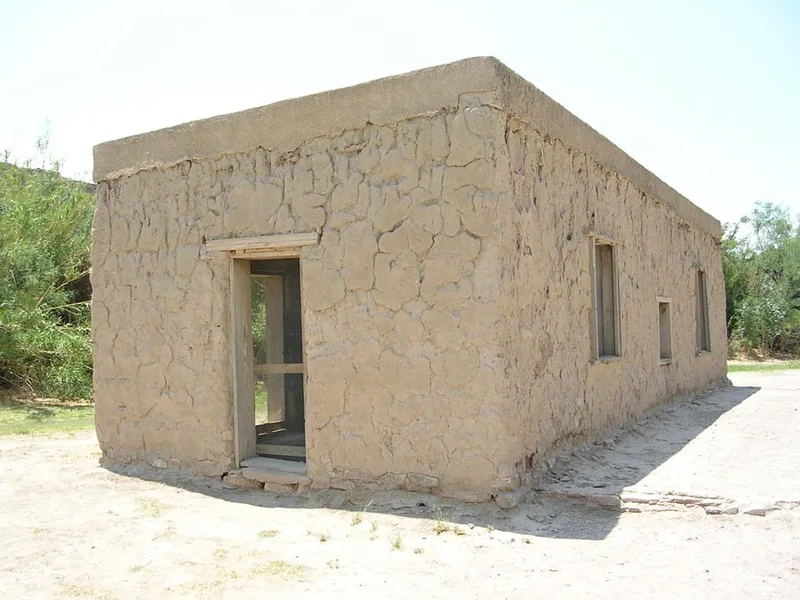
Daniels Farm House is a simple two-room adobe building beside the Rio Grande in Big Bend National Park, roughly 44 feet long and 15 feet wide, set on a stone rubble foundation. John O. Wedin, a Swedish immigrant and experienced Kansas wheat farmer, built it in 1918 after installing a centrifugal pump irrigation system, and he used it to store farm equipment. Joe Graham, a West Texas cattleman, bought the farm in 1926, expanded the acreage and tied crops to his cattle operation. In 1937 John and Mary Coe Daniels bought the upper portion, enlarged the house to two rooms, opened a small store serving residents on both sides of the border, and grew cotton. After the park was established in 1944, nearly all other traces of this farming disappeared. The house, its remaining ditch and the outlines of old fields are presented as the last physical evidence of irrigated farming in the region. The roof and plaster date from a 1972 rehabilitation.
Significance in brief: The nomination argues the house is significant under Criterion A for its link to the social, cultural and economic development of the Big Bend. It is described as the last remaining physical representation of irrigated and flood-plain farming along the lower Rio Grande. Successive owners Wedin, Joe Graham and John R. Daniels shaped commercial farming in a region dominated by stock raising.
Machine-generated summary. This summary was generated by a language model from the official nomination document and has not been reviewed line by line by an editor. It may contain errors. Check the source document before relying on any detail. Source: nomination document (PDF) · National Archives catalog entry. NRHP reference 89001627, listed October 20, 1989. Summary generated October 2026 (model claude-sonnet-5-5, prompt v1.0-2026-10-29, confidence medium).
Key facts
| Address | W of Rio Grande Village in Big Bend National Park, Rio Grande Village |
|---|---|
| County | Brewster County |
| Listed | October 20, 1989 |
| Reference number | 89001627 |
| Resource type | Building |
| Architect / builder | John O. Wedin; John R. Daniels |
| Architectural style | Traditional Southwest architectural style |
| Criteria |
|
| Areas of significance | Economics, Agriculture |
| Level of significance | Local |
| Status (as stated in the nomination) | Marked unoccupied and deteriorated and altered; the 1972 roof shows serious deterioration, with fractured vigas held by vertical supports, and interior walls are scarred by graffiti. |
| Acreage | 0.2 |
| Coordinates | 29.18585, -102.97202 (NPS GIS) |
What listing means for this property
National Register listing is honorary for a privately owned home: it does not by itself restrict what an owner may do with their own money, and it does not require public access. Restrictions come from local landmark or historic-district ordinances, which are separate (how they differ).
Owner-occupied houses are not eligible for the 20% federal rehabilitation tax credit, which applies to income-producing buildings, but many states offer credits for homeowners. Listing also opens the door to preservation easements and to buying a plaque. Start with what listing means for homeowners, renovating a listed house and selling one.
Noted as vacant in the nomination. Nomination documents can be decades old; current status may differ. If you are considering buying an empty listed property, read the due-diligence checklist.
General information, not legal or tax advice. Rules change; confirm with your State Historic Preservation Office or a qualified adviser.
Sources and further reading
- National Park Service, National Register of Historic Places database (snapshot May 2026), reference 89001627.
- Nomination form (PDF, National Archives) — catalog entry
- Wikipedia article (used for cross-checking only; text not reproduced here)
- Wikidata Q5219476
- This listing as JSON
Last updated October 2026. Found an error? See the editorial policy for how to report it.