Varner-Hogg Plantation
Also known as: Varner-Hogg State Historical Park

Why it's listed
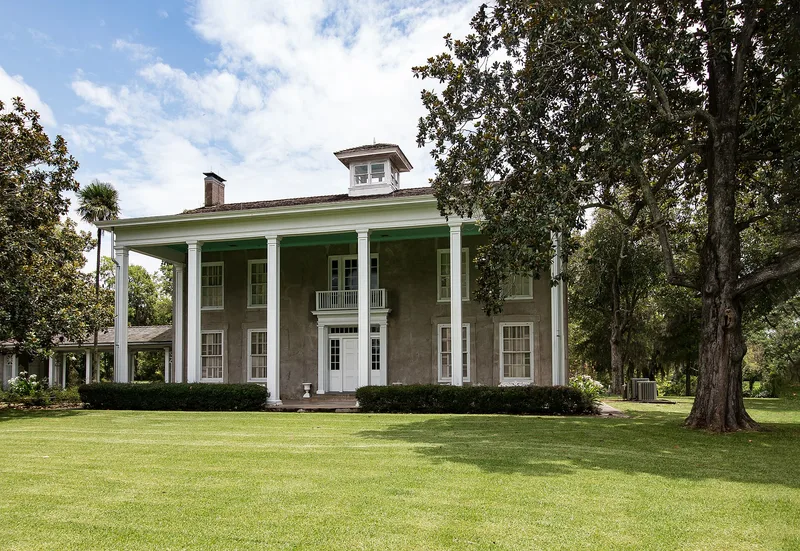
Set on a magnolia-shaded slope above flood level near West Columbia, this plantation began in 1824 when Martin Varner received a league of land in Stephen F. Austin's colony. Varner grew sugarcane and is credited as the first colonist in Texas to distill rum from molasses. In 1834 he sold to Columbus R. Patton, who developed a productive sugar plantation worked by as many as 60 slaves and probably built the brick main house. Governor James S. Hogg bought 4,100 acres in 1901, and his children remodeled the house in 1920 after the West Columbia oil field came in, adding stucco, square columns and a colonnaded breezeway to the kitchen wing. Ima Hogg furnished the house with nineteenth-century antiques in 1956 and gave it with 52.67 acres to the State of Texas as a park. Brick foundations of the sugar mill, cisterns, a cemetery and extensive archives add to its research value.
Significance in brief: The nomination calls it a rare surviving homestead from Stephen F. Austin's original 'Old Three Hundred' colony. It is associated with settler Martin Varner, planter Columbus R. Patton, and Governor James S. Hogg and his philanthropist children Will and Ima Hogg. It also has archival value and archeological potential in its ruins.
Machine-generated summary. This summary was generated by a language model from the official nomination document and has not been reviewed line by line by an editor. It may contain errors. Check the source document before relying on any detail. Source: nomination document (PDF) · National Archives catalog entry. NRHP reference 80004082, listed April 9, 1980. Summary generated October 2026 (model claude-sonnet-5-5, prompt v1.0-2026-10-29, confidence high).
Key facts
| Address | 2 mi. NE of West Columbia off SR 2852, West Columbia |
|---|---|
| County | Brazoria County |
| Listed | April 9, 1980 |
| Reference number | 80004082 |
| Resource type | Building |
| Period of significance | 1800-1899, 1900- |
| Architect / builder | Columbus R. Patton (?) |
| Architectural style | Greek Revival proportions and details |
| Areas of significance | Commerce, Agriculture, Exploration/Settlement, Politics/Government |
| Level of significance | State |
| Status (as stated in the nomination) | Operated by the State of Texas as a state historical park and museum; condition listed as good, altered, on its original site. |
| Acreage | 65.7 |
| Coordinates | 29.16384, -95.64084 (NPS GIS) |
What listing means for this property
National Register listing is honorary for a privately owned home: it does not by itself restrict what an owner may do with their own money, and it does not require public access. Restrictions come from local landmark or historic-district ordinances, which are separate (how they differ).
Owner-occupied houses are not eligible for the 20% federal rehabilitation tax credit, which applies to income-producing buildings, but many states offer credits for homeowners. Listing also opens the door to preservation easements and to buying a plaque. Start with what listing means for homeowners, renovating a listed house and selling one.
General information, not legal or tax advice. Rules change; confirm with your State Historic Preservation Office or a qualified adviser.
Sources and further reading
- National Park Service, National Register of Historic Places database (snapshot May 2026), reference 80004082.
- Nomination form (PDF, National Archives) — catalog entry
- Wikipedia article (used for cross-checking only; text not reproduced here)
- Wikidata Q7916031
- This listing as JSON
Last updated October 2026. Found an error? See the editorial policy for how to report it.