Lyndon B. Johnson National Historical Park

Why it's listed
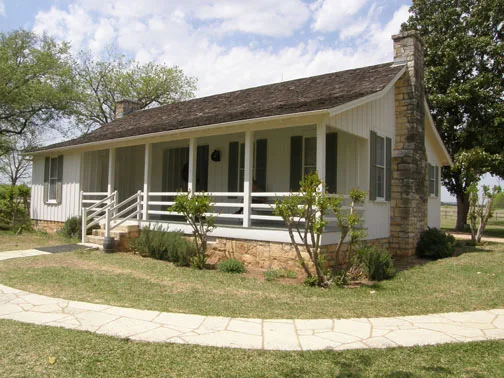
Two units in the Texas hill country make up this historic park, which traces the life of Lyndon B. Johnson, the 36th president. The Johnson City Unit covers 39.44 acres and centers on the Boyhood Home, a one-story frame house restored to its late 1920s appearance, and the Johnson Settlement, where his grandfather ran an open-range cattle business from 1867 to 1872. The settlement includes a restored dog-trot log cabin, a stone horse barn and a large stone barn built in 1884. Fifteen miles west, the 201.37-acre LBJ Ranch Unit holds the Texas White House, a 28-room stone and frame house expanded between 1952 and 1967 from an earlier stone house. Nearby are the cabana and pool, barns, a communications tower, the one-room Junction School where Johnson studied and later signed an education bill, his grandfather's farmhouse, and the Family Cemetery where he is buried. Together they document more than a century of his family's story.
Significance in brief: The resources document the life of Lyndon B. Johnson, 36th president, from his grandparents' frontier settlement through his boyhood, his political rise, the presidential years at the ranch, and his retirement and burial in the Family Cemetery. The ranch unit is described as the larger and more significant of the two. Together the buildings cover more than 100 years of the family's heritage.
Machine-generated summary. This summary was generated by a language model from the official nomination document and has not been reviewed line by line by an editor. It may contain errors. Check the source document before relying on any detail. Source: nomination document (PDF) · National Archives catalog entry. NRHP reference 69000202, listed December 2, 1969. Summary generated October 2026 (model claude-sonnet-5-5, prompt v1.0-2026-10-29, confidence medium).
Key facts
| Address | Lyndon B. Johnson National Historical Park, Johnson City |
|---|---|
| County | Blanco County |
| Listed | December 2, 1969 |
| Reference number | 69000202 |
| Resource type | District |
| Areas of significance | Politics/Government |
| Level of significance | National |
| National Historic Landmark | Yes, designated May 23, 1966 |
| Status (as stated in the nomination) | Condition is marked excellent and altered. Many structures were restored or reconstructed by the National Park Service in the 1970s. The Ranch House was still lived in by Mrs. Johnson, and only its exterior was interpreted. |
| Acreage | 1571 |
| Coordinates | 30.27129, -98.41500 (NPS GIS) |
What listing means for this property
This is a historic district. Buildings within its boundary are either contributing (they add to the district's significance) or non-contributing. Owners of contributing income-producing buildings can claim the 20% federal rehabilitation tax credit; homeowners should look at state credits. National Register districts impose no design review by themselves; a local historic district ordinance, if one exists, does (the difference explained).
General information, not legal or tax advice. Rules change; confirm with your State Historic Preservation Office or a qualified adviser.
Sources and further reading
- National Park Service, National Register of Historic Places database (snapshot May 2026), reference 69000202.
- Nomination form (PDF, National Archives) — catalog entry
- Wikipedia article (used for cross-checking only; text not reproduced here)
- Wikidata Q637458
- This listing as JSON
Last updated October 2026. Found an error? See the editorial policy for how to report it.