Huebner-Onion Homestead and Stagecoach Stop
Also known as: Huebner Settlement
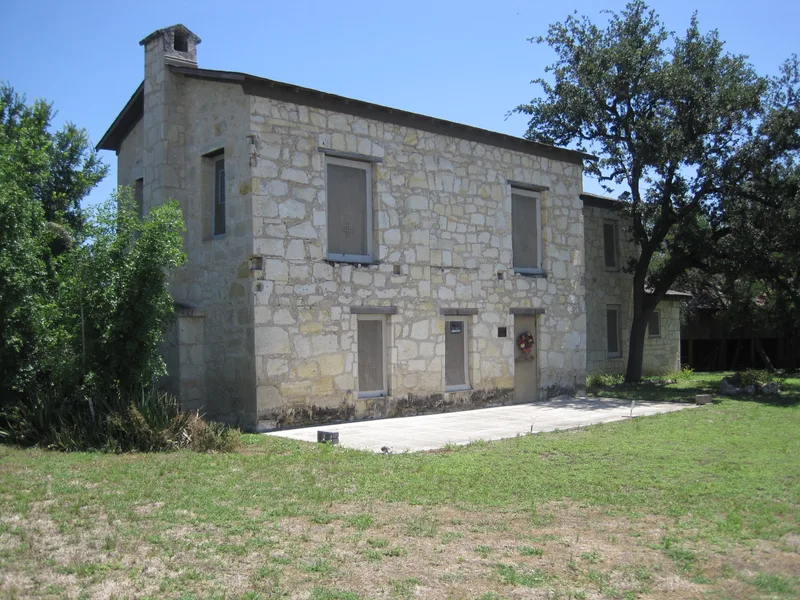

Why it's listed
Beside Bandera Road in Leon Valley, northwest of downtown San Antonio, sits a half-acre complex of three limestone buildings: a two-story ranch house, a stone barn and a small roofless dependency that probably served first as a residence and then as a kitchen. German immigrant stockman Joseph Huebner built the original one-story house in 1862, using local limestone as many German settlers did rather than the log construction favored by Anglo-Texans. A second story was added in 1882. The ranch also worked as a change-out station where stagecoaches and freight wagons swapped horses and mules on the route between San Antonio and Bandera, at the foot of Nine Mile Hill. In the 1930s Judge John F. Onion bought the property and added two compatible wings for his family. Now vacant, the buildings have been stabilized by the Historical Society of Leon Valley, which hopes to restore them as an interpretive living-history site.
Significance in brief: The nomination argues the site is significant under Criterion A for Settlement and Community Planning and Development. It served as the Huebner family ranch headquarters and as a horse and mule change-out station for stagecoaches and freight wagons traveling between San Antonio and Bandera. It was later a home for Judge John F. Onion's family, and it retains a high degree of integrity.
Machine-generated summary. This summary was generated by a language model from the official nomination document and has not been reviewed line by line by an editor. It may contain errors. Check the source document before relying on any detail. Source: nomination document (PDF) · National Archives catalog entry. NRHP reference 05000860, listed August 10, 2005. Summary generated October 2026 (model claude-sonnet-5-5, prompt v1.0-2026-10-29, confidence high).
Key facts
| Address | 6613 Bandera Rd., Leon Valley |
|---|---|
| County | Bexar County |
| Listed | August 10, 2005 |
| Reference number | 05000860 |
| Resource type | Building |
| Period of significance | 1862-1955 |
| Architect / builder | Huebner, Joseph; Onion, John F., Sr. |
| Architectural style | OTHER: Two-story, limestone block rectangle |
| Criteria |
|
| Areas of significance | Exploration/Settlement, Community Planning and Development |
| Level of significance | Local |
| Status (as stated in the nomination) | Vacant and sealed; stabilized and mothballed by the Historical Society of Leon Valley, which plans restoration as a living-history site, though the buildings remain vulnerable to vandalism and deterioration. |
| Acreage | 0.9 |
| Coordinates | 29.49615, -98.61705 (NPS GIS) |
What listing means for this property
National Register listing is honorary for a privately owned home: it does not by itself restrict what an owner may do with their own money, and it does not require public access. Restrictions come from local landmark or historic-district ordinances, which are separate (how they differ).
Owner-occupied houses are not eligible for the 20% federal rehabilitation tax credit, which applies to income-producing buildings, but many states offer credits for homeowners. Listing also opens the door to preservation easements and to buying a plaque. Start with what listing means for homeowners, renovating a listed house and selling one.
Noted as vacant in the nomination. Nomination documents can be decades old; current status may differ. If you are considering buying an empty listed property, read the due-diligence checklist.
General information, not legal or tax advice. Rules change; confirm with your State Historic Preservation Office or a qualified adviser.
Sources and further reading
- National Park Service, National Register of Historic Places database (snapshot May 2026), reference 05000860.
- Nomination form (PDF, National Archives) — catalog entry
- Wikidata Q110002745
- This listing as JSON
Last updated October 2026. Found an error? See the editorial policy for how to report it.