Elgin Commercial Historic District

Why it's listed
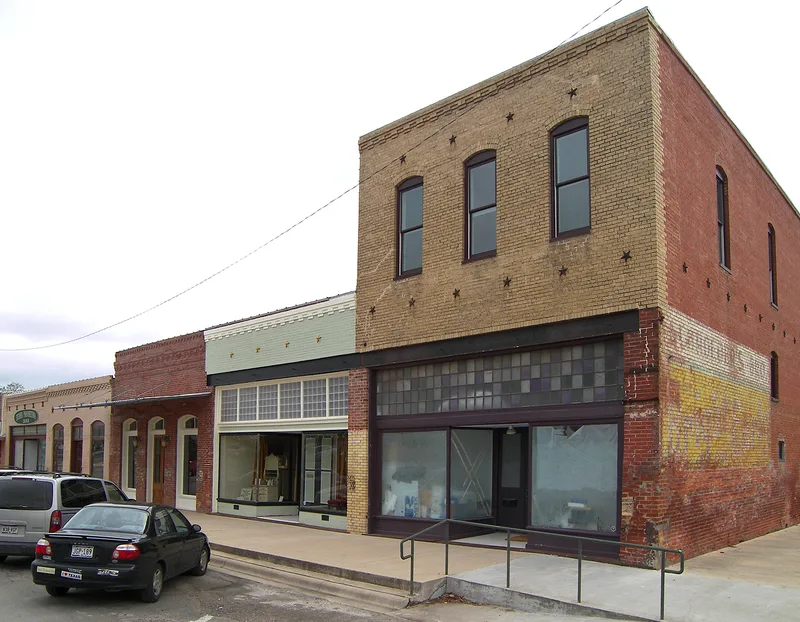
Elgin's historic commercial core is a fourteen-block area of brick storefronts, industrial buildings and railroad-related sites in Bastrop County, Texas. The Houston & Texas Central Railroad platted the town in 1872, and the oldest surviving building is its freight depot. Buildings along Main Street, Depot Avenue and Central Avenue are mostly one- and two-story commercial blocks, many with Italianate touches, built from 1872 to 1947. Red brick was used in earlier buildings and buff brick after about 1910, laid up with corbelling and dentil courses. Landmarks include the 1906 Bassist Opera House, the Union Depot of about 1903 and the 1923 Elgin National Bank. Cotton-related industrial buildings lie along the Katy rail line to the east. The district was listed because the railroads and the cotton and lumber trade built Elgin's mercantile center, and because the brickwork reflects the town's brick industry. About 67 of its 80 resources contribute to that history and retain their integrity.
Significance in brief: The district shows how the railroads and the agricultural economy, especially cotton, shaped Elgin's growth as a trading and mercantile center. Its brick buildings, with corbelled and dentiled detailing, also reflect the local brick industry and typical small-town Italianate and vernacular commercial block design. It is judged significant at the local level.
Machine-generated summary. This summary was generated by a language model from the official nomination document and has not been reviewed line by line by an editor. It may contain errors. Check the source document before relying on any detail. Source: nomination document (PDF) · National Archives catalog entry. NRHP reference 96000024, listed February 16, 1996. Summary generated October 2026 (model claude-sonnet-5-5, prompt v1.0-2026-10-29, confidence high).
Key facts
| Address | Roughly, along Main St., Ave. C, Central and Depot Aves. and 1st and 2nd Sts., Elgin |
|---|---|
| County | Bastrop County |
| Listed | February 16, 1996 |
| Reference number | 96000024 |
| Resource type | District |
| Period of significance | 1872-1947 |
| Architectural style | Late Victorian: Italianate; Classical Revival; vernacular 1- and 2-part commercial blocks |
| Criteria |
|
| Areas of significance | Commerce, Architecture |
| Level of significance | Local |
| Status (as stated in the nomination) | Most buildings remain occupied by merchants and government offices; some, mainly on the southside, are in relatively poor condition. |
| Acreage | 45 |
| Coordinates | 30.34523, -97.36960 (NPS GIS) |
What listing means for this property
This is a historic district. Buildings within its boundary are either contributing (they add to the district's significance) or non-contributing. Owners of contributing income-producing buildings can claim the 20% federal rehabilitation tax credit; homeowners should look at state credits. National Register districts impose no design review by themselves; a local historic district ordinance, if one exists, does (the difference explained).
General information, not legal or tax advice. Rules change; confirm with your State Historic Preservation Office or a qualified adviser.
Sources and further reading
- National Park Service, National Register of Historic Places database (snapshot May 2026), reference 96000024.
- Nomination form (PDF, National Archives) — catalog entry
- Wikidata Q109999634
- This listing as JSON
Last updated October 2026. Found an error? See the editorial policy for how to report it.