Berkheimer, Henry and Elizabeth, Farm

Why it's listed
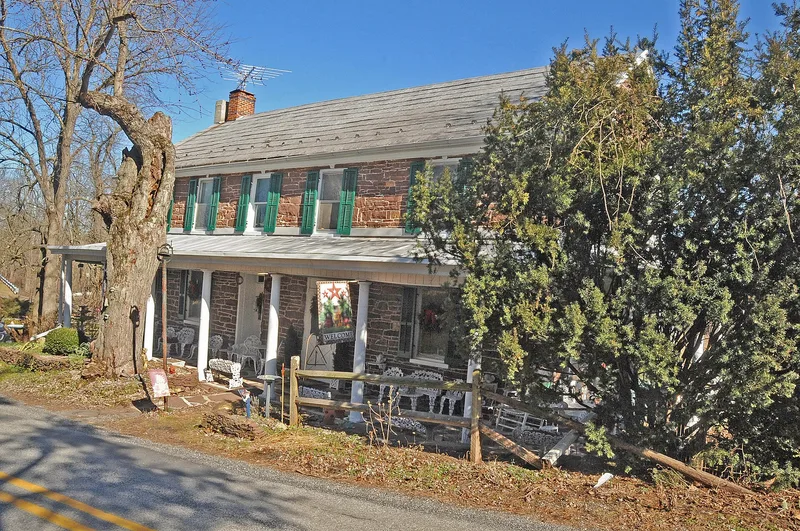
Berkheimer Farm lies within a loop of Bermudian Creek in western York County, Pennsylvania, and was developed from 1815 by Henry and Elizabeth Berkheimer, who bought the land that year. Its farmhouse, dated 1817 by a datestone, is built of rough-cut brownstone quarried from the surrounding fields, with massive quoins and a metal-shingled gable roof. The 1847 Sweitzer barn is of heavy timber pegged mortise-and-tenon construction. Henry Berkheimer operated a wool carding and fulling mill on the property, a service rare in the county at that time, and the mill was dismantled after Lewis Berkheimer closed it. The farm was sold in 1908 to Hattie and Jacob Baker, ending 93 years of Berkheimer ownership. The farm is significant for its agricultural history and its Pennsylvania German building traditions, and the surviving buildings reflect its growth from 1815 to 1928.
Significance in brief: The nomination argues the farm is a strong representative example of a typical York County farm of the 19th and early 20th centuries, under agriculture. Its built resources are also said to reflect Pennsylvania German culture and the evolution of the agricultural environment, under architecture. The farm also includes a woolen carding mill operated by the Berkheimers.
Machine-generated summary. This summary was generated by a language model from the official nomination document and has not been reviewed line by line by an editor. It may contain errors. Check the source document before relying on any detail. Source: nomination document (PDF) · National Archives catalog entry. NRHP reference 00001382, listed November 15, 2000. Summary generated October 2026 (model claude-haiku-5-5, prompt v1.1-2026-10-29, confidence medium).
Key facts
| Address | 240 Bentz Mill Rd., Washington Township |
|---|---|
| County | York County |
| Listed | November 15, 2000 |
| Reference number | 00001382 |
| Resource type | Building |
| Period of significance | 1815-1928 |
| Architectural style | Pennsylvania German vernacular |
| Criteria |
|
| Areas of significance | Agriculture, Architecture |
| Level of significance | Local |
| Status (as stated in the nomination) | Historic farm with a 1920s-era farmhouse porch and modern enclosures; the document does not state current use beyond agricultural cultivation. |
| Acreage | 100 |
| Coordinates | 40.04256, -77.01225 (NPS GIS) |
What listing means for this property
National Register listing is honorary for a privately owned home: it does not by itself restrict what an owner may do with their own money, and it does not require public access. Restrictions come from local landmark or historic-district ordinances, which are separate (how they differ).
Owner-occupied houses are not eligible for the 20% federal rehabilitation tax credit, which applies to income-producing buildings, but many states offer credits for homeowners. Listing also opens the door to preservation easements and to buying a plaque. Start with what listing means for homeowners, renovating a listed house and selling one.
General information, not legal or tax advice. Rules change; confirm with your State Historic Preservation Office or a qualified adviser.
Sources and further reading
- National Park Service, National Register of Historic Places database (snapshot May 2026), reference 00001382.
- Nomination form (PDF, National Archives) — catalog entry
- Wikipedia article (used for cross-checking only; text not reproduced here)
- Wikidata Q5730678
- This listing as JSON
Last updated October 2026. Found an error? See the editorial policy for how to report it.