Old White Mill
Also known as: Sterling Mill & Pinnock Mill

Approximate location: the National Park Service places this pin arbitrarily within the property, not at a surveyed point (stated accuracy ±12 m).
Why it's listed
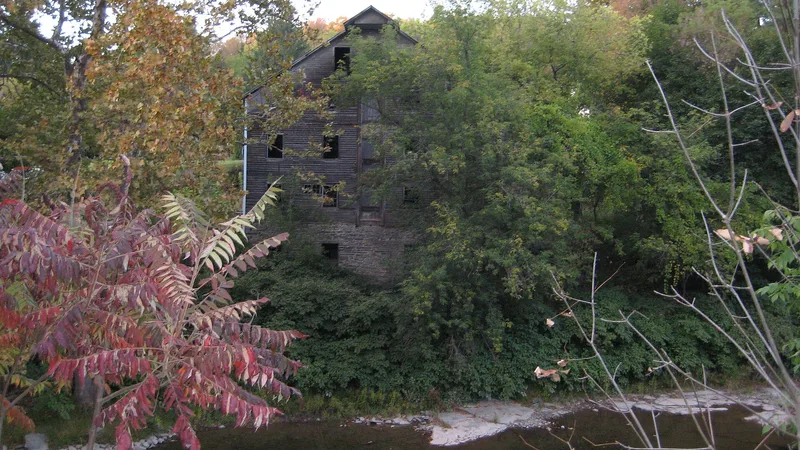
Built in 1852 in Meshoppen by G. M. Hollenback, N. Overfield, and D. T. Sterling at a cost of $12,000, the Old White Mill is a wooden grist mill of five and a half stories built into a bank. Its frame rises from a foundation of cut-faced quarry stone, and most of its interior is finished in chestnut. The mill takes its name from its white paint, which set it apart from other mills in the area. A large metal water wheel in the lower two stories powered the operation, supplemented by a turbine used when water levels were high. An auger-type elevator carried raw grain to the top floor. The mill furnished flour and feed to a broad agricultural district, which gave it a significant role in the local economy. Nicholas Overfield, a state representative, was among its original owners. Architecturally, it is regarded as an example of a mid-nineteenth century grist mill, with its original equipment largely intact.
Significance in brief: The nomination argues the mill played a large part in the area's economic history by supplying flour and feed to a large agricultural hinterland. It is presented as an example of a mid-nineteenth century grist mill, with its stone foundations and chestnut interior, and its original equipment, including grain bins, elevators, turbine, and scales, is noted as preserved.
Machine-generated summary. This summary was generated by a language model from the official nomination document and has not been reviewed line by line by an editor. It may contain errors. Check the source document before relying on any detail. Source: nomination document (PDF) · National Archives catalog entry. NRHP reference 75001680, listed September 11, 1975. Summary generated October 2026 (model claude-haiku-5-5, prompt v1.1-2026-10-29, confidence medium).
Key facts
| Address | Off Welles St., Meshoppen |
|---|---|
| County | Wyoming County |
| Listed | September 11, 1975 |
| Reference number | 75001680 |
| Resource type | Building |
| Period of significance | 1852 |
| Architect / builder | G. M. Hollenback, N. Overfield, and D. T. Sterling (builders) |
| Areas of significance | Industry, Architecture |
| Level of significance | Local |
| Status (as stated in the nomination) | The mill has not undergone major structural changes since 1852 and original equipment is still in the mill; the scales are now broken. |
| Acreage | 0.6 |
| Coordinates | 41.61411, -76.04635 (NPS GIS) |
What listing means for this property
For an income-producing building, listing (individually or as a contributing building in a district) is the gateway to the 20% federal rehabilitation tax credit on qualified rehabilitation costs, often stackable with state credits. Work claiming the credit must follow the Secretary of the Interior's Standards and be approved in advance.
Listing does not restrict a private owner acting without federal money or permits; where federal funding or licensing is involved, Section 106 review applies.
General information, not legal or tax advice. Rules change; confirm with your State Historic Preservation Office or a qualified adviser.
Sources and further reading
- National Park Service, National Register of Historic Places database (snapshot May 2026), reference 75001680.
- Nomination form (PDF, National Archives) — catalog entry
- Wikipedia article (used for cross-checking only; text not reproduced here)
- Wikidata Q7085416
- This listing as JSON
Last updated October 2026. Found an error? See the editorial policy for how to report it.