Salem Crossroads Historic District
Also known as: Delmont
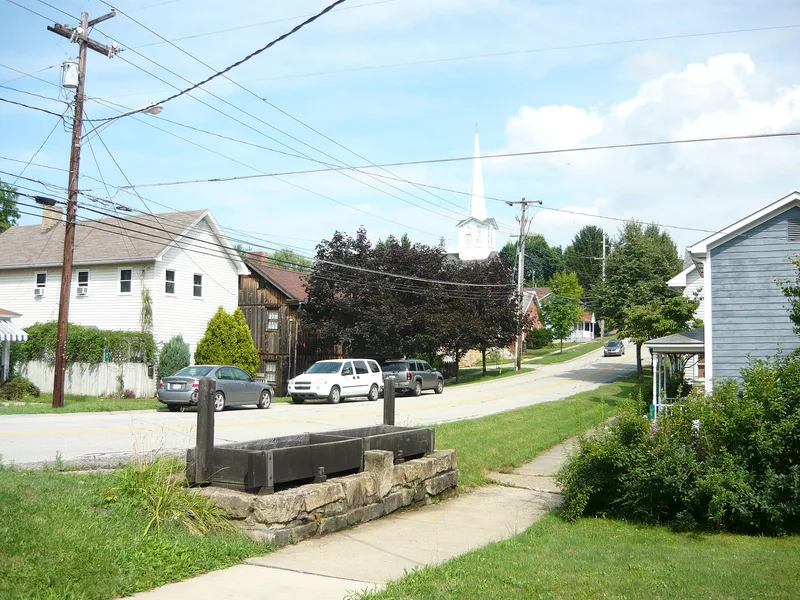

Why it's listed
Salem Crossroads, now Delmont, lies along the Old Northern Pike about 23 miles east of Pittsburgh. Laid out by Thomas Wilson in 1814 into 48 lots, the town grew around a junction of two principal stage routes and at one time was served by as many as five stage coach lines. Taverns, storekeepers, wagonmakers, tanners and harnessmakers depended on the traffic of Conestoga wagons and livestock drovers heading west. Most of the district's buildings date from about 1830 to 1870 and are predominantly brick Greek Revival houses, with some Italianate detailing, a Gothic Revival church built in 1868 and a Queen Anne house. The district is significant as a well-documented example of a stage-era crossroads town, and the nomination ties its decline to the Pennsylvania Railroad, which reached Greensburg in 1852 by a route that bypassed the community.
Significance in brief: The nomination argues the district preserves a crossroads community that prospered from stage travel and turnpike traffic in the early nineteenth century. It cites the town's taverns, stores and trades, and the decline that followed the arrival of the Pennsylvania Railroad in 1852, which bypassed the community. The district's Greek Revival buildings are presented as the predominant building form.
Machine-generated summary. This summary was generated by a language model from the official nomination document and has not been reviewed line by line by an editor. It may contain errors. Check the source document before relying on any detail. Source: nomination document (PDF) · National Archives catalog entry. NRHP reference 78002484, listed September 18, 1978. Summary generated October 2026 (model claude-haiku-5-5, prompt v1.1-2026-10-29, confidence medium).
Key facts
| Address | Pittsburgh and Greenburg Sts., Delmont |
|---|---|
| County | Westmoreland County |
| Listed | September 18, 1978 |
| Reference number | 78002484 |
| Resource type | District |
| Period of significance | 1830-1870 |
| Architectural style | Greek Revival; Italianate; Gothic Revival; Queen Anne |
| Areas of significance | Transportation |
| Level of significance | Local |
| Status (as stated in the nomination) | Several buildings are noted as altered, enclosed, or sided, and the Central Hotel is described as still standing and to be restored. |
| Acreage | 20 |
| Coordinates | 40.41283, -79.57011 (NPS GIS) |
What listing means for this property
This is a historic district. Buildings within its boundary are either contributing (they add to the district's significance) or non-contributing. Owners of contributing income-producing buildings can claim the 20% federal rehabilitation tax credit; homeowners should look at state credits. National Register districts impose no design review by themselves; a local historic district ordinance, if one exists, does (the difference explained).
General information, not legal or tax advice. Rules change; confirm with your State Historic Preservation Office or a qualified adviser.
Sources and further reading
- National Park Service, National Register of Historic Places database (snapshot May 2026), reference 78002484.
- Nomination form (PDF, National Archives) — catalog entry
- Wikipedia article (used for cross-checking only; text not reproduced here)
- Wikidata Q7404087
- This listing as JSON
Last updated October 2026. Found an error? See the editorial policy for how to report it.