Plumer House

Why it's listed
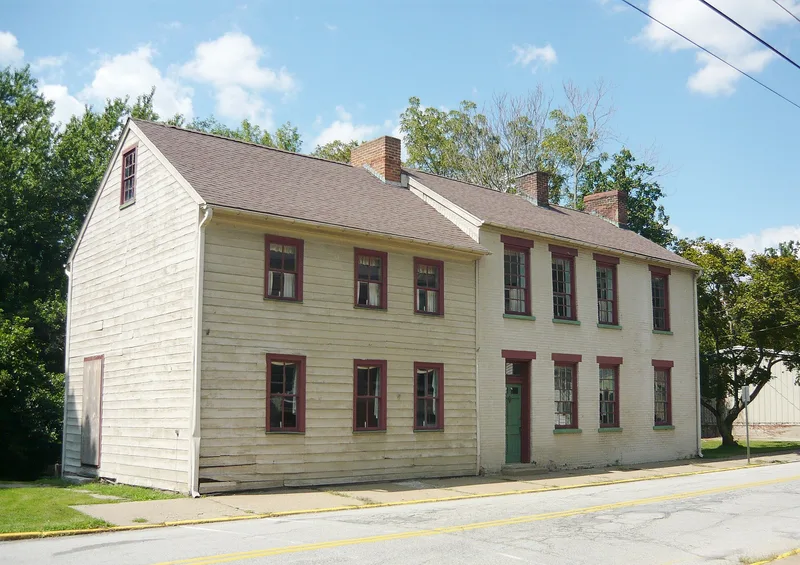
Built on Water Street beside the Youghiogheny River in West Newton, the house began as a frame dwelling in 1814 for John Campbell Plumer, who had married Elizabeth Peairs that April. A brick addition followed in 1846. The original section has two rooms on each floor, and the addition adds rooms and a hall, with a recessed paneled door and a transom. Plumer ran a grist mill and saw mill that he enlarged into one of the largest in the area, and he built a dam across the river with a lock to keep navigation open. He also supervised construction of a toll bridge that replaced the ferry at West Newton. Elected to the state legislature in 1830 and the Pennsylvania Senate in 1839, he was known locally as Squire Plumer. The house is regarded as a good example of early frontier building and a surviving link to the region's river trade, roads, and railroad development. It was threatened with sale in 1965, which led to the founding of the historical society that saved it.
Significance in brief: The nomination argues the house is a good example of an early nineteenth-century frontier dwelling and is tied to the Plumer family, whose members were prominent in the region. Plumer ran mills, helped build a toll bridge, held military, legislative and local office, and was active in the Presbyterian church and in promoting free schools. The house is also presented as a surviving link to the river trade, the Baltimore and Ohio Railroad, and the early history of West Newton.
Machine-generated summary. This summary was generated by a language model from the official nomination document and has not been reviewed line by line by an editor. It may contain errors. Check the source document before relying on any detail. Source: nomination document (PDF) · National Archives catalog entry. NRHP reference 79002368, listed December 6, 1979. Summary generated October 2026 (model claude-haiku-5-5, prompt v1.1-2026-10-29, confidence medium).
Key facts
| Address | Vine and S. Water St., West Newton |
|---|---|
| County | Westmoreland County |
| Listed | December 6, 1979 |
| Reference number | 79002368 |
| Resource type | Building |
| Period of significance | 1814: 1846 |
| Architect / builder | John C. Plumer |
| Areas of significance | Exploration/Settlement |
| Level of significance | Local |
| Status (as stated in the nomination) | Restored under the West Newton Historical Society, which bought the property in 1965 and later turned title to the borough. |
| Acreage | 0.4 |
| Coordinates | 40.20916, -79.76924 (NPS GIS) |
What listing means for this property
National Register listing is honorary for a privately owned home: it does not by itself restrict what an owner may do with their own money, and it does not require public access. Restrictions come from local landmark or historic-district ordinances, which are separate (how they differ).
Owner-occupied houses are not eligible for the 20% federal rehabilitation tax credit, which applies to income-producing buildings, but many states offer credits for homeowners. Listing also opens the door to preservation easements and to buying a plaque. Start with what listing means for homeowners, renovating a listed house and selling one.
General information, not legal or tax advice. Rules change; confirm with your State Historic Preservation Office or a qualified adviser.
Sources and further reading
- National Park Service, National Register of Historic Places database (snapshot May 2026), reference 79002368.
- Nomination form (PDF, National Archives) — catalog entry
- Wikipedia article (used for cross-checking only; text not reproduced here)
- Wikidata Q7205422
- This listing as JSON
Last updated October 2026. Found an error? See the editorial policy for how to report it.