Greensburg Downtown Historic District
Also known as: See Also:Westmoreland County Courthouse; Greensburg Railroad

Why it's listed
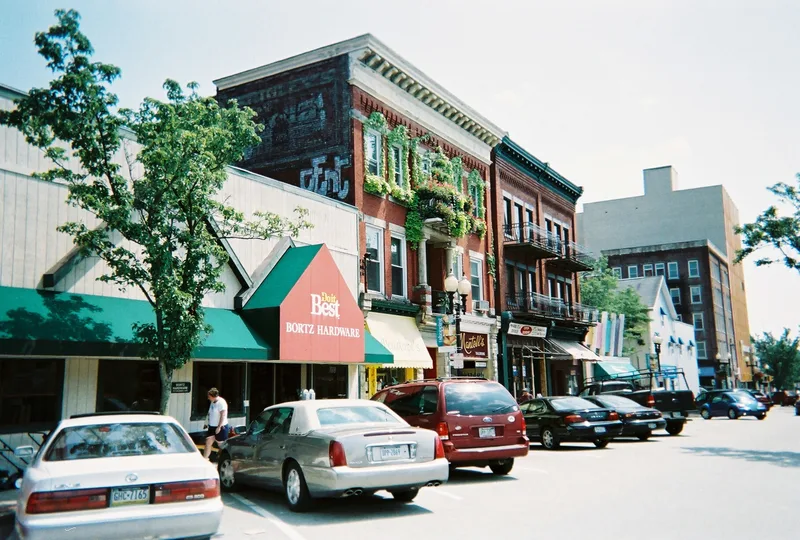
Greensburg's downtown grid, laid out by Christopher Truby and William Jack around the county courthouse site, forms a district of commercial, governmental, social and religious buildings. Most were built between 1872 and 1930 in brick and stone, often with carved stone, terra-cotta and cement ornament. The Westmoreland County Courthouse, completed in 1906 at a cost of about $1,250,000, anchors the district and is the fourth courthouse on the site. Coal money drove its growth: companies such as Jamison Coal and Coke and Westmoreland-Fayette Coal and Coke kept offices on Main Street, and the Pennsylvania Railroad's Main Line made the town a coal shipping center. Banks, hotels, theaters such as the Palace Theatre of 1926-27, and churches including the 1919 First Presbyterian Church by Ralph Adams Cram were built in the same boom. The district holds 79 contributing buildings, and the nomination treats its streetscapes and architecture as the main reasons for listing.
Significance in brief: The nomination argues the district is significant in commerce, politics and government, and architecture for the period 1870 to 1945. Its commercial role came from coal company offices, retail trade and rail transport, and its government role from the county seat function. Its architecture is represented by a large number of largely intact buildings, including the Westmoreland County Courthouse, designed by William Kauffman and completed in 1906, and the Pennsylvania Railroad station of 1912.
Machine-generated summary. This summary was generated by a language model from the official nomination document and has not been reviewed line by line by an editor. It may contain errors. Check the source document before relying on any detail. Source: nomination document (PDF) · National Archives catalog entry. NRHP reference 95000884, listed July 21, 1995. Summary generated October 2026 (model claude-haiku-5-5, prompt v1.1-2026-10-29, confidence high).
Key facts
| Address | Roughly bounded by Tunnel St., Main St., Third St. and Harrison Ave., Greensburg |
|---|---|
| County | Westmoreland County |
| Listed | July 21, 1995 |
| Reference number | 95000884 |
| Resource type | District |
| Period of significance | 1870-1945 |
| Architect / builder | William Kauffman (architect, Westmoreland County Courthouse); William H. Cookman (designer, Greensburg Railroad Station); Ralph Adams Cram (designer, First Presbyterian Church) |
| Architectural style | Italianate, Romanesque Revival, Classic Revival, Georgian Revival, Moderne, Gothic Revival |
| Criteria |
|
| Areas of significance | Commerce, Politics/Government, Architecture |
| Level of significance | Local |
| Status (as stated in the nomination) | Most ground floors are professional offices and retail businesses, with apartments or offices above; the railroad station is being rehabilitated for adaptive reuse. |
| Acreage | 21.8 |
| Coordinates | 40.30176, -79.54417 (NPS GIS) |
What listing means for this property
This is a historic district. Buildings within its boundary are either contributing (they add to the district's significance) or non-contributing. Owners of contributing income-producing buildings can claim the 20% federal rehabilitation tax credit; homeowners should look at state credits. National Register districts impose no design review by themselves; a local historic district ordinance, if one exists, does (the difference explained).
General information, not legal or tax advice. Rules change; confirm with your State Historic Preservation Office or a qualified adviser.
Sources and further reading
- National Park Service, National Register of Historic Places database (snapshot May 2026), reference 95000884.
- Nomination form (PDF, National Archives) — catalog entry
- Wikipedia article (used for cross-checking only; text not reproduced here)
- Wikidata Q5604497
- This listing as JSON
Last updated October 2026. Found an error? See the editorial policy for how to report it.