Fort Ligonier Site

Why it's listed
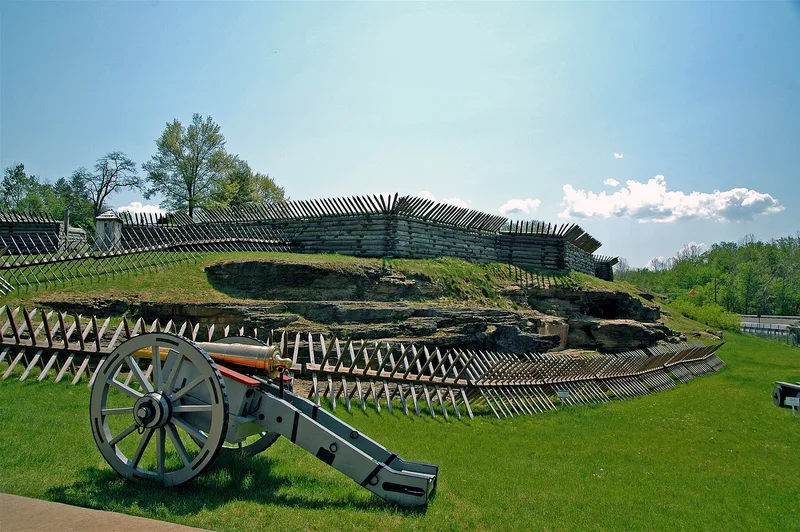
Reconstructed on its original ground in Ligonier, Westmoreland County, Fort Ligonier is a British fort of the French and Indian War. It was the last in a chain of fortifications built along the Forbes Road in 1758 to protect supply lines during General John Forbes's campaign against Fort Duquesne. Originally called the Camp at Loyal Hanna and briefly Pittsborough, it was renamed for Field Marshal Sir John Ligonier after the French abandoned Fort Duquesne in November 1758. The fort held out against a major French and Indian attack in October 1758, a defense that contributed to the French withdrawal and gave the British control of the Forks of the Ohio. Garrisons remained until the fort was decommissioned in 1766. Reconstruction began in 1947 using documentary research and archaeology, including excavations by Jacob L. Grimm from 1960 to 1965. The rebuilt stockade, bastions, gates and log buildings are regarded as highly accurate. Its artifact collection is considered the most complete of French and Indian War material.
Significance in brief: The fort was the last of a series of fortifications built along the Forbes Road during the 1758 British campaign against Fort Duquesne. It withstood a major French and Indian attack in October 1758, which the nomination says contributed to the French abandonment of Fort Duquesne. The archaeological collection of French and Indian War artifacts is described as the most complete of its kind.
Machine-generated summary. This summary was generated by a language model from the official nomination document and has not been reviewed line by line by an editor. It may contain errors. Check the source document before relying on any detail. Source: nomination document (PDF) · National Archives catalog entry. NRHP reference 75001678, listed January 21, 1975. Summary generated October 2026 (model claude-haiku-5-5, prompt v1.1-2026-10-29, confidence medium).
Key facts
| Address | S. Market St., Ligonier |
|---|---|
| County | Westmoreland County |
| Listed | January 21, 1975 |
| Reference number | 75001678 |
| Resource type | Site |
| Period of significance | 1758-1759 |
| Architect / builder | Charles M. Stotz (restoration architect) |
| Criteria |
|
| Areas of significance | Military |
| Level of significance | Local |
| Status (as stated in the nomination) | Reconstructed; approximately 80% of the original site is occupied by the reconstruction, and the Fort Ligonier Memorial Foundation owns that 80%. |
| Acreage | 15 |
| Coordinates | 40.24080, -79.23743 (NPS GIS) |
What listing means for this property
Sites (archaeological sites, battlefields, landscapes) are often listed with a restricted address to protect them from looting or disturbance. Listing is honorary for private owners; federal undertakings on or near the site go through Section 106 review, and state laws may protect burials and artefacts regardless of listing.
General information, not legal or tax advice. Rules change; confirm with your State Historic Preservation Office or a qualified adviser.
Sources and further reading
- National Park Service, National Register of Historic Places database (snapshot May 2026), reference 75001678.
- Nomination form (PDF, National Archives) — catalog entry
- Wikipedia article (used for cross-checking only; text not reproduced here)
- Wikidata Q5471515
- This listing as JSON
Last updated October 2026. Found an error? See the editorial policy for how to report it.