Acheson, Edward G., House
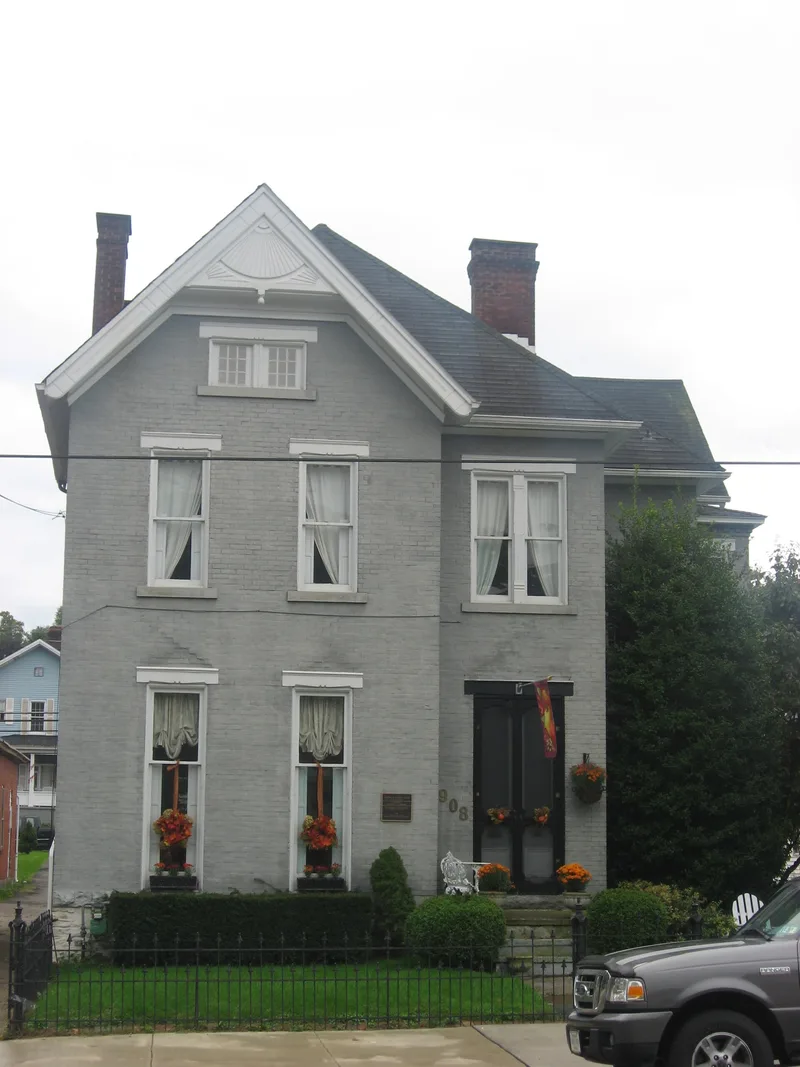

Why it's listed
A detached 2-1/2 story brick house at 908 Main Street in Monongahela, Pennsylvania, probably built in the 1870s. Its builder and architect are not known, and the house is described as a plain vernacular domestic building with an asymmetrical plan, a front double bay, a side projection and a two-story service wing. Edward Goodrich Acheson lived here from 1890 to 1895. In March 1891 he conducted experiments in Monongahela that led to carborundum, or silicon carbide, an artificial abrasive harder than any substance previously known. Local tradition and the owner's account place the discovery in a summer kitchen that Acheson converted into a small laboratory, though the house itself is the documented location. Acheson later developed graphite products from the same thermochemical process and held nearly 70 patents. He received the Rumford Premium in 1908 and the Perkins Medal in 1910. The house is listed for its association with this invention and with Acheson's career as an inventor.
Significance in brief: The nomination argues the house is significant because Edward Goodrich Acheson invented carborundum (silicon carbide) while living there from 1890 to 1895, probably in a summer kitchen converted to a laboratory. The architecture is described as vernacular and of no architectural significance, so the listing rests on the invention and its association with Acheson.
Machine-generated summary. This summary was generated by a language model from the official nomination document and has not been reviewed line by line by an editor. It may contain errors. Check the source document before relying on any detail. Source: nomination document (PDF) · National Archives catalog entry. NRHP reference 76001679, listed May 11, 1976. Summary generated October 2026 (model claude-haiku-5-5, prompt v1.1-2026-10-29, confidence medium).
Key facts
| Address | 908 Main St., Monongahela |
|---|---|
| County | Washington County |
| Listed | May 11, 1976 |
| Reference number | 76001679 |
| Resource type | Building |
| Period of significance | 1890-1895 |
| Areas of significance | Invention |
| Level of significance | National |
| National Historic Landmark | Yes, designated May 11, 1976 |
| Status (as stated in the nomination) | The present owner's account and the form describe the house as unaltered apart from removal of a frame wash house and interior kitchen and laundry changes; the form lists its condition as excellent. |
| Acreage | 0.9 |
| Coordinates | 40.20553, -79.93424 (NPS GIS) |
What listing means for this property
National Register listing is honorary for a privately owned home: it does not by itself restrict what an owner may do with their own money, and it does not require public access. Restrictions come from local landmark or historic-district ordinances, which are separate (how they differ).
Owner-occupied houses are not eligible for the 20% federal rehabilitation tax credit, which applies to income-producing buildings, but many states offer credits for homeowners. Listing also opens the door to preservation easements and to buying a plaque. Start with what listing means for homeowners, renovating a listed house and selling one.
General information, not legal or tax advice. Rules change; confirm with your State Historic Preservation Office or a qualified adviser.
Sources and further reading
- National Park Service, National Register of Historic Places database (snapshot May 2026), reference 76001679.
- Nomination form (PDF, National Archives) — catalog entry
- Wikipedia article (used for cross-checking only; text not reproduced here)
- Wikidata Q5343028
- This listing as JSON
Last updated October 2026. Found an error? See the editorial policy for how to report it.