Franklin Historic District

Why it's listed
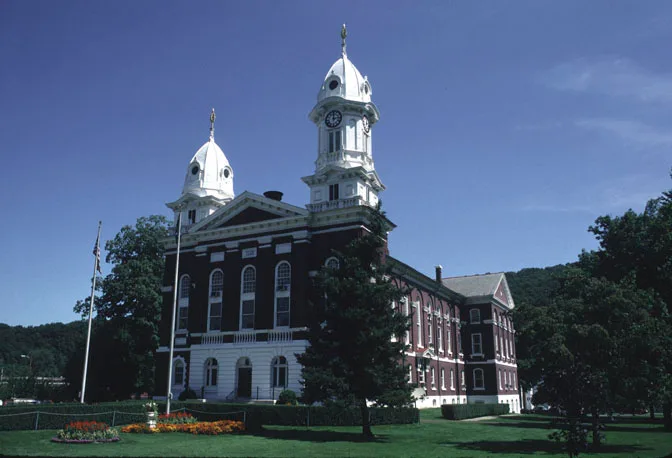
Franklin's historic district covers 26 city blocks along the Allegheny River and French Creek in Venango County, containing 410 buildings, of which 380 contribute to its character. Construction began in 1830 with frame houses and Greek Revival dwellings brought by settlers from southeastern Pennsylvania and New England, and it accelerated after 1860 when oil wealth funded Italianate, Second Empire and Queen Anne houses. The Italianate house at 307 South Park Street, built for Senator Thomas Hoge in 1865, is singled out as the finest example. The district is valued for its range: nearly every major architectural style used in northwestern Pennsylvania between 1830 and 1930 appears here, often in several examples that allow comparison. Its compact layout also preserves a tangible record of the oil boom that transformed a small river town into a city of nearly 7,000 people by 1873.
Significance in brief: The nomination argues the district's primary significance is its architecture: nearly every major style used in northwestern Pennsylvania from 1830 to 1930 is represented, often in multiple examples that allow comparison. It also holds regional importance for its comprehensiveness and compactness and as a tangible link to the early oil industry that financed much of its construction.
Machine-generated summary. This summary was generated by a language model from the official nomination document and has not been reviewed line by line by an editor. It may contain errors. Check the source document before relying on any detail. Source: nomination document (PDF) · National Archives catalog entry. NRHP reference 84003583, listed January 26, 1984. Summary generated October 2026 (model claude-haiku-5-5, prompt v1.1-2026-10-29, confidence medium).
Key facts
| Address | Roughly bounded by Miller Ave., Otter, 8th, Buffalo, and 16th Sts., Franklin |
|---|---|
| County | Venango County |
| Listed | January 26, 1984 |
| Reference number | 84003583 |
| Resource type | District |
| Period of significance | 1830-1930 |
| Architectural style | Federal; Greek Revival; Gothic Revival; Italianate; Italian Villa; Second Empire; Queen Anne; Stick; Colonial Revival; Arts and Crafts |
| Criteria |
|
| Areas of significance | Industry, Architecture |
| Level of significance | Local |
| Acreage | 152.9 |
| Coordinates | 41.39432, -79.83611 (NPS GIS) |
What listing means for this property
This is a historic district. Buildings within its boundary are either contributing (they add to the district's significance) or non-contributing. Owners of contributing income-producing buildings can claim the 20% federal rehabilitation tax credit; homeowners should look at state credits. National Register districts impose no design review by themselves; a local historic district ordinance, if one exists, does (the difference explained).
General information, not legal or tax advice. Rules change; confirm with your State Historic Preservation Office or a qualified adviser.
Sources and further reading
- National Park Service, National Register of Historic Places database (snapshot May 2026), reference 84003583.
- Nomination form (PDF, National Archives) — catalog entry
- Wikipedia article (used for cross-checking only; text not reproduced here)
- Wikidata Q15218397
- This listing as JSON
Last updated October 2026. Found an error? See the editorial policy for how to report it.