Nutting Hall

Why it's listed
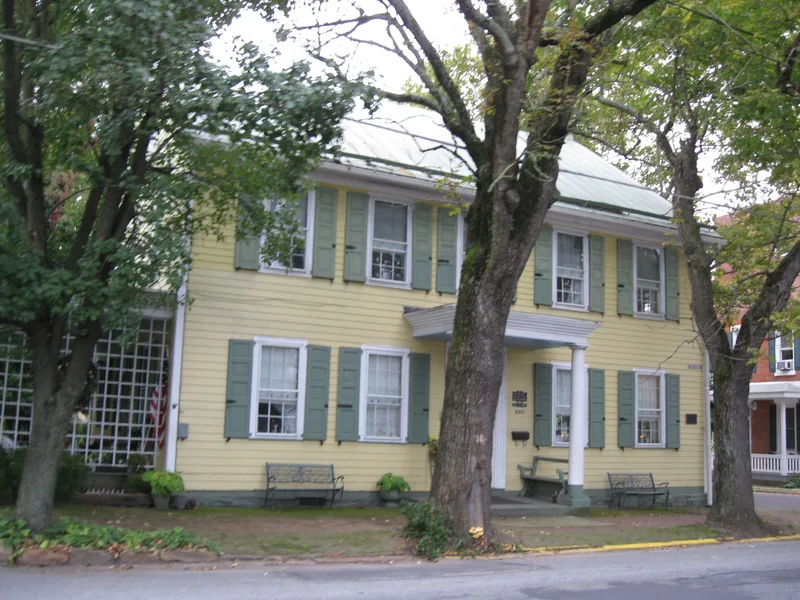
Nutting Hall is a two-and-a-half-story frame house in Pine Grove, Schuylkill County, built between 1823 and 1825 by Peter Filbert, a trained carpenter who also ran the nearby Pine Grove Forge and brick yard. Its L-shaped plan has a central hall, nine-over-six windows, and a stone foundation with a full basement. Original woodwork, hardware, shutters and flooring survive throughout, and the kitchen ell holds a large walk-in fireplace. The house was built for landowner Christian Ley and later passed to William Graeff, a tanner who became an early coal operator, and then to James L. Nutting, a local educator and coal and iron businessman who died there in 1880. Its construction shows Germanic framing traits, and it is regarded as one of the early homes of the region's coal and land-owning families. The novelist Conrad Richter drew on the house for his book Always Young and Fair.
Significance in brief: The nomination argues the house is one of the earliest homes built for the wealthy coal operators and landowners of the Southern Anthracite Field, and that its braced frame construction with cross bracing recalls Germanic half-timber methods brought by Palatine immigrants. It is also associated with the Pine Grove industrial and commercial development of the early 1800s and with the author Conrad Richter, who based a novel on it. Its original woodwork, hardware, shutters and siding remain largely intact.
Machine-generated summary. This summary was generated by a language model from the official nomination document and has not been reviewed line by line by an editor. It may contain errors. Check the source document before relying on any detail. Source: nomination document (PDF) · National Archives catalog entry. NRHP reference 80003627, listed July 23, 1980. Summary generated October 2026 (model claude-haiku-5-5, prompt v1.1-2026-10-29, confidence medium).
Key facts
| Address | 205 S. Tulpehocken St., Pine Grove |
|---|---|
| County | Schuylkill County |
| Listed | July 23, 1980 |
| Reference number | 80003627 |
| Resource type | Building |
| Period of significance | 1823-1825 |
| Architect / builder | Peter Filbert (architect and builder) |
| Architectural style | Federal vernacular |
| Areas of significance | Law, Architecture |
| Level of significance | Local |
| Status (as stated in the nomination) | Nutting Hall is in excellent condition according to the statement of significance; a fire escape was added in 1969. |
| Acreage | 0.5 |
| Coordinates | 40.54689, -76.38445 (NPS GIS) |
What listing means for this property
National Register listing is honorary for a privately owned home: it does not by itself restrict what an owner may do with their own money, and it does not require public access. Restrictions come from local landmark or historic-district ordinances, which are separate (how they differ).
Owner-occupied houses are not eligible for the 20% federal rehabilitation tax credit, which applies to income-producing buildings, but many states offer credits for homeowners. Listing also opens the door to preservation easements and to buying a plaque. Start with what listing means for homeowners, renovating a listed house and selling one.
General information, not legal or tax advice. Rules change; confirm with your State Historic Preservation Office or a qualified adviser.
Sources and further reading
- National Park Service, National Register of Historic Places database (snapshot May 2026), reference 80003627.
- Nomination form (PDF, National Archives) — catalog entry
- Wikipedia article (used for cross-checking only; text not reproduced here)
- Wikidata Q7070585
- This listing as JSON
Last updated October 2026. Found an error? See the editorial policy for how to report it.