Nyce Farm
Also known as: Van Gordon House
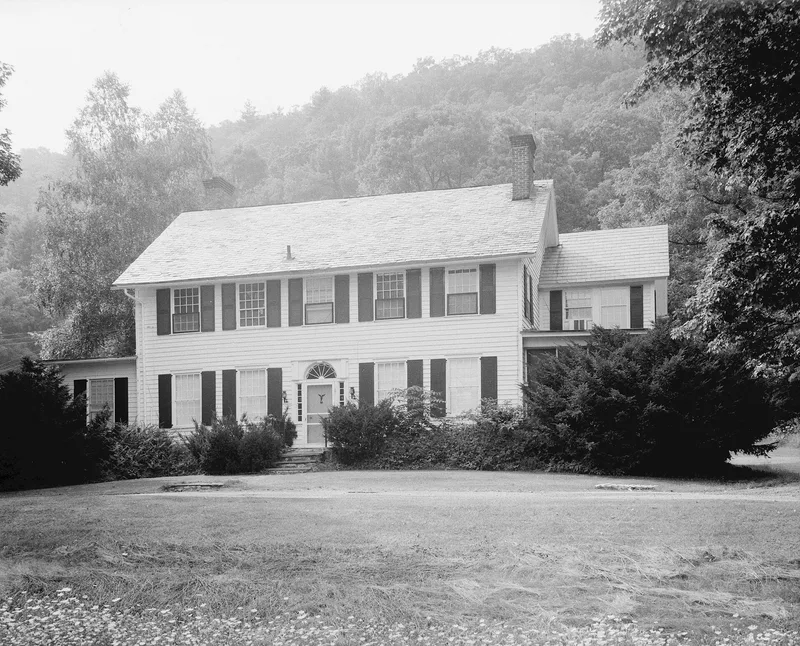

Why it's listed
Nyce Farm is a complex of seven buildings on the Pennsylvania side of the Upper Delaware River, set at the foot of a steep wooded ridge about a quarter mile from the water. Jacobus Van Gordon, a Revolutionary War soldier, acquired part of the tract in the 1770s and built a small stone cabin at the base of the ridge. In the early 19th century George Nyce acquired the property and built the large, five-bay center hall farmhouse that now anchors the group. Nyce introduced advanced equipment, including a threshing machine, and built a slate-roofed barn in the early 1860s. The farm was a stage stop on the River Road between Stroudsburg and Milford and remained in the Nyce family until 1948. It is regarded as a well-preserved example of the prosperous river-bottom farming that developed in the Upper Delaware Valley.
Significance in brief: The complex is argued to be a link in the agricultural development of the Pennsylvania river bottom lands of the Upper Delaware Valley. Its fertile river-flat land, early occupancy and adaptation to mechanized farming after the Civil War allowed its owners to remain prosperous while much of the area's agriculture declined. It is described as one of the best preserved such tracts in terms of historic and architectural integrity.
Machine-generated summary. This summary was generated by a language model from the official nomination document and has not been reviewed line by line by an editor. It may contain errors. Check the source document before relying on any detail. Source: nomination document (PDF) · National Archives catalog entry. NRHP reference 79000240, listed July 23, 1979. Summary generated October 2026 (model claude-haiku-5-5, prompt v1.1-2026-10-29, confidence medium).
Key facts
| Address | NW of Bushkill on U.S. 209, Bushkill |
|---|---|
| County | Pike County |
| Listed | July 23, 1979 |
| Reference number | 79000240 |
| Resource type | Building |
| Architectural style | Federal Period farmhouse (house resembles 18th century New England houses; conventional center hall type) |
| Areas of significance | Agriculture, Exploration/Settlement, Architecture |
| Level of significance | Local |
| Status (as stated in the nomination) | The farm is described as a working farm, with the outbuildings in generally good condition and the Tenant House in generally poor condition. |
| Acreage | 7 |
| Coordinates | 41.14002, -74.93027 (NPS GIS) |
What listing means for this property
National Register listing is honorary for a privately owned home: it does not by itself restrict what an owner may do with their own money, and it does not require public access. Restrictions come from local landmark or historic-district ordinances, which are separate (how they differ).
Owner-occupied houses are not eligible for the 20% federal rehabilitation tax credit, which applies to income-producing buildings, but many states offer credits for homeowners. Listing also opens the door to preservation easements and to buying a plaque. Start with what listing means for homeowners, renovating a listed house and selling one.
General information, not legal or tax advice. Rules change; confirm with your State Historic Preservation Office or a qualified adviser.
Sources and further reading
- National Park Service, National Register of Historic Places database (snapshot May 2026), reference 79000240.
- Nomination form (PDF, National Archives) — catalog entry
- Wikipedia article (used for cross-checking only; text not reproduced here)
- Wikidata Q7070972
- This listing as JSON
Last updated October 2026. Found an error? See the editorial policy for how to report it.