Grey, Zane, House (Boundary Increase)

Why it's listed
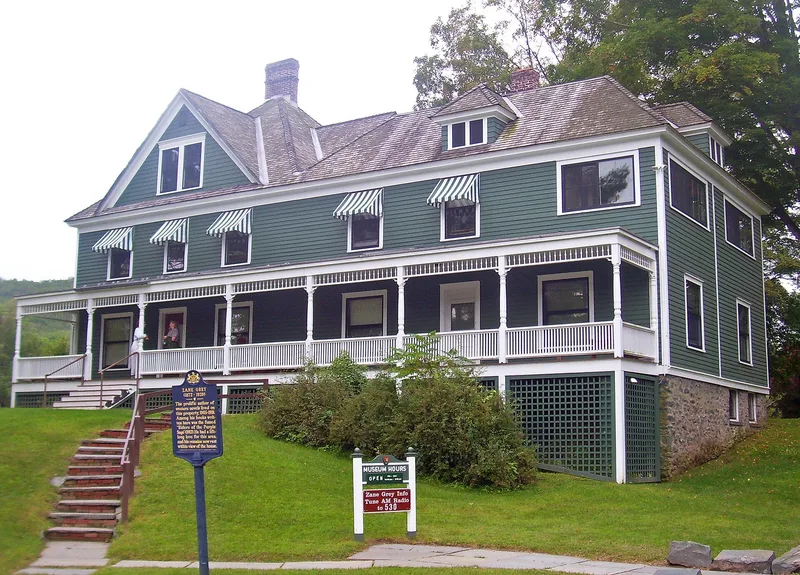
Built in 1906 by Romer Grey, brother of the novelist Zane Grey, this two-story wood-frame house sits on a bluestone foundation on a rise above Scenic Drive in Lackawaxen, Pennsylvania, overlooking the Delaware River. Zane Grey bought the house in 1914, and additions in 1915 and 1916 gave it the rectangular footprint it has today. The property is significant for its connection to Grey's early literary career. He wrote several of his first Westerns here, including The Heritage of the Desert, published in 1910, and Riders of the Purple Sage, which became his first best-seller in 1912. Grey drew on trips to the American West, which he began in 1906, and the Lackawaxen setting shaped his early work. His novels helped establish the formula that defined the Western in American fiction and film. The period of significance runs from 1906 to 1929, the last year Grey visited the property.
Significance in brief: The house is argued to be significant for its association with the early career of novelist Zane Grey, whose Western novels helped establish the Western as a major genre in American literature and film. Grey wrote many of his early Western works there, and the nomination argues the property was the base from which he traveled West for material.
Machine-generated summary. This summary was generated by a language model from the official nomination document and has not been reviewed line by line by an editor. It may contain errors. Check the source document before relying on any detail. Source: nomination document (PDF) · National Archives catalog entry. NRHP reference 11000231, listed April 29, 2011. Summary generated October 2026 (model claude-haiku-5-5, prompt v1.1-2026-10-29, confidence medium).
Key facts
| Address | 135 Lackawaxen Scenic Dr., Lackawaxen |
|---|---|
| County | Pike County |
| Listed | April 29, 2011 |
| Reference number | 11000231 |
| Resource type | Building |
| Period of significance | 1906-1929 |
| Architect / builder | Romer Grey (builder of the original 1906 house) |
| Architectural style | Four Square |
| Criteria |
|
| Areas of significance | Literature |
| Level of significance | National |
| Status (as stated in the nomination) | Property is owned by the National Park Service |
| Acreage | 3.2 |
| Coordinates | 41.48538, -74.98781 (NPS GIS) |
What listing means for this property
National Register listing is honorary for a privately owned home: it does not by itself restrict what an owner may do with their own money, and it does not require public access. Restrictions come from local landmark or historic-district ordinances, which are separate (how they differ).
Owner-occupied houses are not eligible for the 20% federal rehabilitation tax credit, which applies to income-producing buildings, but many states offer credits for homeowners. Listing also opens the door to preservation easements and to buying a plaque. Start with what listing means for homeowners, renovating a listed house and selling one.
General information, not legal or tax advice. Rules change; confirm with your State Historic Preservation Office or a qualified adviser.
Sources and further reading
- National Park Service, National Register of Historic Places database (snapshot May 2026), reference 11000231.
- Nomination form (PDF, National Archives) — catalog entry
- Wikipedia article (used for cross-checking only; text not reproduced here)
- Wikidata Q8066104
- This listing as JSON
Last updated October 2026. Found an error? See the editorial policy for how to report it.