Washington Avenue Historic District
Also known as: Washington Avenue Factory District

Why it's listed
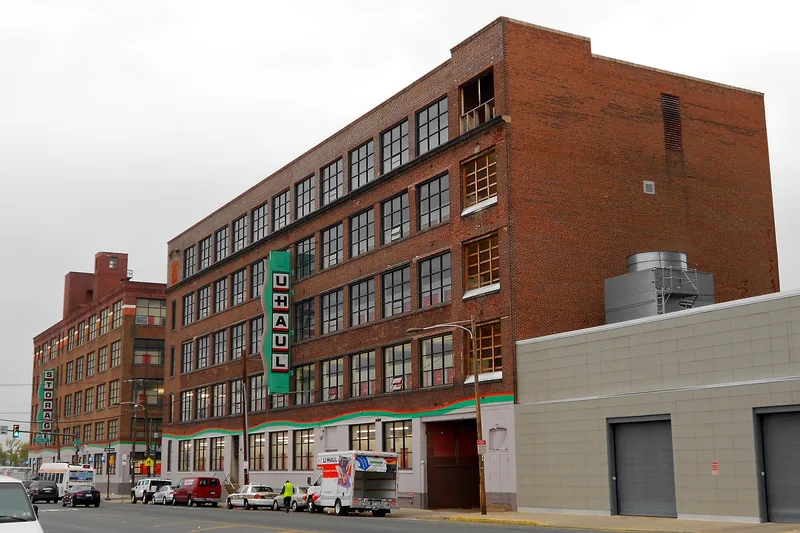
Along the north side of Washington Avenue in Philadelphia stands a row of brick and concrete factories that together form an almost unbroken wall of loft buildings. Built mainly between 1889 and 1927, they were erected when a Philadelphia Wilmington and Baltimore Railroad track ran down the middle of the avenue, allowing goods to move directly between plants. The district held textile mills, a clothing factory, a publishing warehouse, a cigar works, a pharmaceutical plant and a licorice works, and their power plants, coal yards and belting companies served them. Several of the buildings were designed by leading industrial architects, notably Hales and Ballinger, whose firm developed separate stair and fire towers and efficient factory layouts. The district is regarded as a nearly unique survival of a work community in which men, women and children worked side by side, and it illustrates how Philadelphia's manufacturing economy functioned around 1900.
Significance in brief: The nomination argues the district is one of the last significant concentrations of industrial loft buildings in Philadelphia and a nearly unique surviving workplace that shows how factories, power plants, coal yards, belting makers and worker housing functioned together. It also argues the buildings were designed by several important industrial architects and were built for prominent Philadelphia manufacturers.
Machine-generated summary. This summary was generated by a language model from the official nomination document and has not been reviewed line by line by an editor. It may contain errors. Check the source document before relying on any detail. Source: nomination document (PDF) · National Archives catalog entry. NRHP reference 84003561, listed September 7, 1984. Summary generated October 2026 (model claude-haiku-5-5, prompt v1.1-2026-10-29, confidence medium).
Key facts
| Address | Roughly bounded by Carpenter, Washington, 10th, and Broad Sts., Philadelphia |
|---|---|
| County | Philadelphia |
| Listed | September 7, 1984 |
| Reference number | 84003561 |
| Resource type | District |
| Period of significance | 1889-1927 |
| Architect / builder | Hales and Ballinger; Joseph Huston; Edgar V. Seeler; Nimmons and Fellow (Chicago); William Steele and Sons; Werner Trumbower; Lindley Johnson; Collins and Autenreith; C. E. Rahn; M. Easby |
| Criteria |
|
| Areas of significance | Industry, Architecture, Social History |
| Level of significance | Local |
| Status (as stated in the nomination) | Most buildings are in excellent or good condition, with some original sash replaced or infilled and some later additions. |
| Acreage | 16 |
| Coordinates | 39.93803, -75.16298 (NPS GIS) |
What listing means for this property
This is a historic district. Buildings within its boundary are either contributing (they add to the district's significance) or non-contributing. Owners of contributing income-producing buildings can claim the 20% federal rehabilitation tax credit; homeowners should look at state credits. National Register districts impose no design review by themselves; a local historic district ordinance, if one exists, does (the difference explained).
General information, not legal or tax advice. Rules change; confirm with your State Historic Preservation Office or a qualified adviser.
Sources and further reading
- National Park Service, National Register of Historic Places database (snapshot May 2026), reference 84003561.
- Nomination form (PDF, National Archives) — catalog entry
- Wikipedia article (used for cross-checking only; text not reproduced here)
- Wikidata Q7971679
- This listing as JSON
Last updated October 2026. Found an error? See the editorial policy for how to report it.