St. Joseph's House for Homeless Industrious Boys

Why it's listed
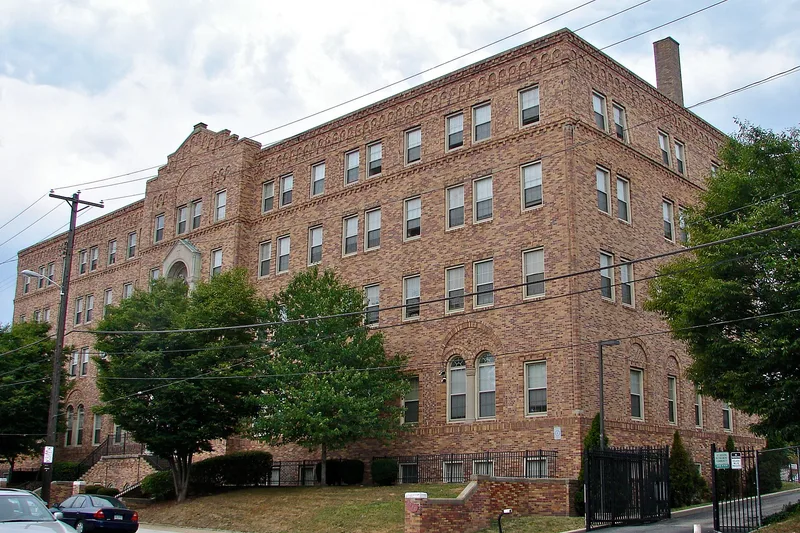
Built in 1929 on Allegheny Avenue at 16th Street in North Philadelphia, the four-story orphanage was designed by the Hoffman-Henon Company in Romanesque Revival style, faced in Bessemer brick over concrete, with a limestone entrance bearing the institution's name. A 1940 gymnasium and auditorium extends along 16th Street, and a printing shop, a Tudor Revival auto house and a Second Empire dwelling complete the group. The institution was founded in 1888 by Reverend Eugene V. McElhone for homeless boys aged 12 to 16, who were taught trades such as printing, shoemaking and tailoring while earning wages. Its vocational and schooling approach is regarded as progressive for its period, and the boys' high school classes began in 1934. The complex is significant for its association with child welfare and education in Philadelphia and for its architecture as a representative institutional building of its era.
Significance in brief: The nomination argues the property is significant for its role in child welfare and education, as St. Joseph's House was among the pioneering Catholic institutions in Philadelphia to offer vocational training and schooling to older boys. Its Romanesque Revival orphanage is presented as a handsome example of the work of the Hoffman-Henon Company, and the complex as a whole is cited as representative of institutional child housing.
Machine-generated summary. This summary was generated by a language model from the official nomination document and has not been reviewed line by line by an editor. It may contain errors. Check the source document before relying on any detail. Source: nomination document (PDF) · National Archives catalog entry. NRHP reference 96001204, listed October 24, 1996. Summary generated October 2026 (model claude-haiku-5-5, prompt v1.1-2026-10-29, confidence medium).
Key facts
| Address | 1511 and 1515--1527 Allegheny Rd., Philadelphia |
|---|---|
| County | Philadelphia |
| Listed | October 24, 1996 |
| Reference number | 96001204 |
| Resource type | Building |
| Period of significance | 1929-1946 |
| Architect / builder | Hoffman-Henon, Co. (architect); Getz, Peter F. (architect); McCloskey & Company (builder); Farrell, Joseph R. (builder) |
| Architectural style | Romanesque Revival; Second Empire; Tudor Revival |
| Criteria |
|
| Areas of significance | Architecture, Social History |
| Level of significance | Local |
| Status (as stated in the nomination) | Orphanage closed by the mid-1970s after the remaining boys were moved to group homes in 1979; the document notes deterioration from neglect and that the summer house in Sea Isle City, NJ, is still used today. |
| Acreage | 1.3 |
| Coordinates | 40.00165, -75.15567 (NPS GIS) |
What listing means for this property
National Register listing is honorary for a privately owned home: it does not by itself restrict what an owner may do with their own money, and it does not require public access. Restrictions come from local landmark or historic-district ordinances, which are separate (how they differ).
Owner-occupied houses are not eligible for the 20% federal rehabilitation tax credit, which applies to income-producing buildings, but many states offer credits for homeowners. Listing also opens the door to preservation easements and to buying a plaque. Start with what listing means for homeowners, renovating a listed house and selling one.
General information, not legal or tax advice. Rules change; confirm with your State Historic Preservation Office or a qualified adviser.
Sources and further reading
- National Park Service, National Register of Historic Places database (snapshot May 2026), reference 96001204.
- Nomination form (PDF, National Archives) — catalog entry
- Wikipedia article (used for cross-checking only; text not reproduced here)
- Wikidata Q7589193
- This listing as JSON
Last updated October 2026. Found an error? See the editorial policy for how to report it.