Presser Home for Retired Music Teachers

Why it's listed
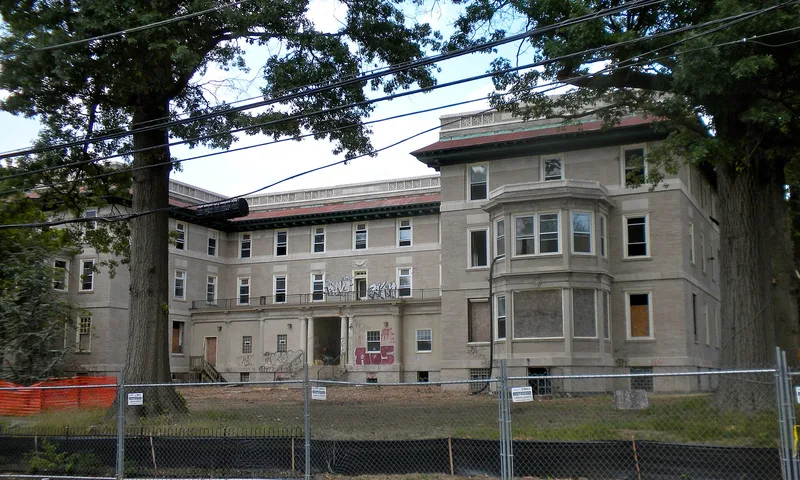
Built in 1914 on Johnson Street in Germantown, this three-story building of buff Roman brick, with limestone and terra cotta ornament, was designed by the Philadelphia firm Seymour & Paul Davis in the Italian Renaissance Revival style. Music publisher Theodore Presser paid for the home, its furnishings and a perpetual endowment, and it opened to about 100 retirees who had taught music for at least 25 years. Applicants had to be at least 65 years old. The home was expanded in 1931 with a steel and concrete wing designed by Davis & Dunlap. It operated as a retirement home until 1980 and as a convalescent home until 2002. The building's villa form, its unusual charitable purpose and its architectural design are the main reasons it was listed. The c.1898 carriage house behind it is also counted as a contributing building.
Significance in brief: The nomination argues the home is an early 20th-century philanthropic institution founded by music publisher Theodore Presser for retired musicians and music teachers, giving it social history significance. It also argues the building is an important institutional example of the Italian Renaissance Revival style with a villa form and an outstanding work of the firm Seymour & Paul Davis.
Machine-generated summary. This summary was generated by a language model from the official nomination document and has not been reviewed line by line by an editor. It may contain errors. Check the source document before relying on any detail. Source: nomination document (PDF) · National Archives catalog entry. NRHP reference 06001006, listed November 8, 2006. Summary generated October 2026 (model claude-haiku-5-5, prompt v1.1-2026-10-29, confidence medium).
Key facts
| Address | 101-121 W. Johnson St., Philadelphia |
|---|---|
| County | Philadelphia |
| Listed | November 8, 2006 |
| Reference number | 06001006 |
| Resource type | Building |
| Period of significance | 1898-1956 |
| Architect / builder | Seymour & Paul Davis (architects); Henry E. Baton (builder) |
| Architectural style | Italian Renaissance Revival |
| Criteria |
|
| Areas of significance | Architecture, Social History |
| Level of significance | Local |
| Status (as stated in the nomination) | Vacant since the convalescent home closed in 2002; the carriage house has not been occupied for many decades. |
| Acreage | 3.5 |
| Within district | Colonial Germantown Historic District |
| Coordinates | 40.04552, -75.18487 (NPS GIS) |
What listing means for this property
National Register listing is honorary for a privately owned home: it does not by itself restrict what an owner may do with their own money, and it does not require public access. Restrictions come from local landmark or historic-district ordinances, which are separate (how they differ).
Owner-occupied houses are not eligible for the 20% federal rehabilitation tax credit, which applies to income-producing buildings, but many states offer credits for homeowners. Listing also opens the door to preservation easements and to buying a plaque. Start with what listing means for homeowners, renovating a listed house and selling one.
Noted as vacant in the nomination. Nomination documents can be decades old; current status may differ. If you are considering buying an empty listed property, read the due-diligence checklist.
General information, not legal or tax advice. Rules change; confirm with your State Historic Preservation Office or a qualified adviser.
Sources and further reading
- National Park Service, National Register of Historic Places database (snapshot May 2026), reference 06001006.
- Nomination form (PDF, National Archives) — catalog entry
- Wikipedia article (used for cross-checking only; text not reproduced here)
- Wikidata Q7241658
- This listing as JSON
Last updated October 2026. Found an error? See the editorial policy for how to report it.