Grumblethorpe
Also known as: Wister`s Big House; See Also:Colonial Germantown Historic Dis
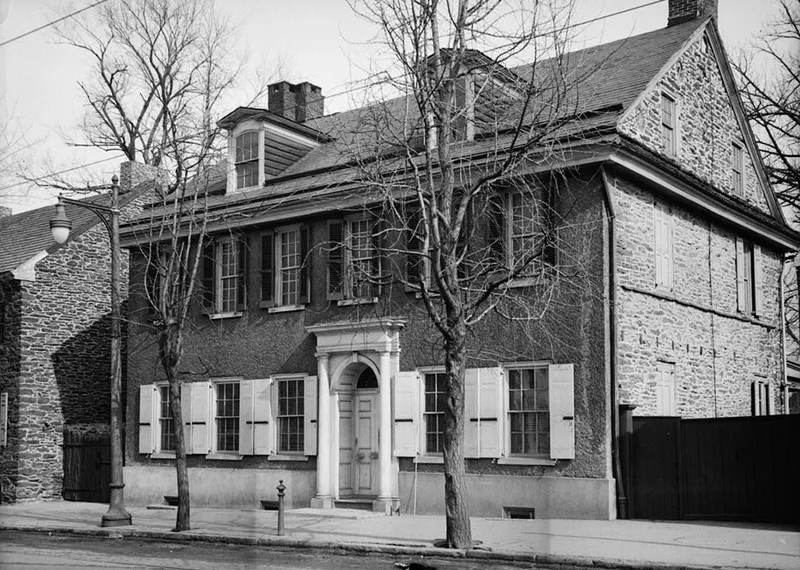

Why it's listed
Built in 1744 as a summer residence in Germantown, Philadelphia, Grumblethorpe is a stone house of two and a half stories with a long rear wing connected by a one-story passage. Its facade is dressed stone, with rubble stone end walls. The house was the home of the Wister family and was known locally as "Wister's Big House" because its dimensions far exceeded those of neighboring houses. It is regarded as the final stage in the development of domestic architecture indigenous to Germantown. During the British occupation of Philadelphia, Brigadier-General James Agnew stayed at the house until the day of the battle in which he was mortally wounded; he died there shortly after being brought back. Visitors also included Louis Philippe, Louis Agassiz, Gilbert Stuart, Thomas Say and John Quincy Adams. The house lies within the Germantown Historic District, a National Historic Landmark.
Significance in brief: The nomination argues the house was the first in Germantown built for summer residency and represents the final stage in the development of domestic architecture indigenous to Germantown. Its size exceeded neighboring houses, earning it the name "Wister's Big House." It also hosted notable guests, including Brigadier-General James Agnew, who was taken there after being mortally wounded during the British occupation of Philadelphia.
Machine-generated summary. This summary was generated by a language model from the official nomination document and has not been reviewed line by line by an editor. It may contain errors. Check the source document before relying on any detail. Source: nomination document (PDF) · National Archives catalog entry. NRHP reference 72001155, listed March 16, 1972. Summary generated October 2026 (model claude-haiku-5-5, prompt v1.1-2026-10-29, confidence medium).
Key facts
| Address | 5267 Germantown Ave., Philadelphia |
|---|---|
| County | Philadelphia |
| Listed | March 16, 1972 |
| Reference number | 72001155 |
| Resource type | Building |
| Period of significance | 1744-1890 |
| Criteria |
|
| Areas of significance | Architecture |
| Level of significance | National |
| Acreage | 0.9 |
| Within district | Colonial Germantown Historic District |
| Coordinates | 40.03205, -75.16848 (NPS GIS) |
What listing means for this property
National Register listing is honorary: it recognises significance and does not restrict what a private owner may do without federal money or permits. It unlocks the 20% federal rehabilitation tax credit for income-producing buildings, state credits in many states, and Section 106 review when federal agencies are involved. See what listing means in practice.
General information, not legal or tax advice. Rules change; confirm with your State Historic Preservation Office or a qualified adviser.
Sources and further reading
- National Park Service, National Register of Historic Places database (snapshot May 2026), reference 72001155.
- Nomination form (PDF, National Archives) — catalog entry
- Wikipedia article (used for cross-checking only; text not reproduced here)
- Wikidata Q5612044
- This listing as JSON
Last updated October 2026. Found an error? See the editorial policy for how to report it.