Klein Meetinghouse

Why it's listed
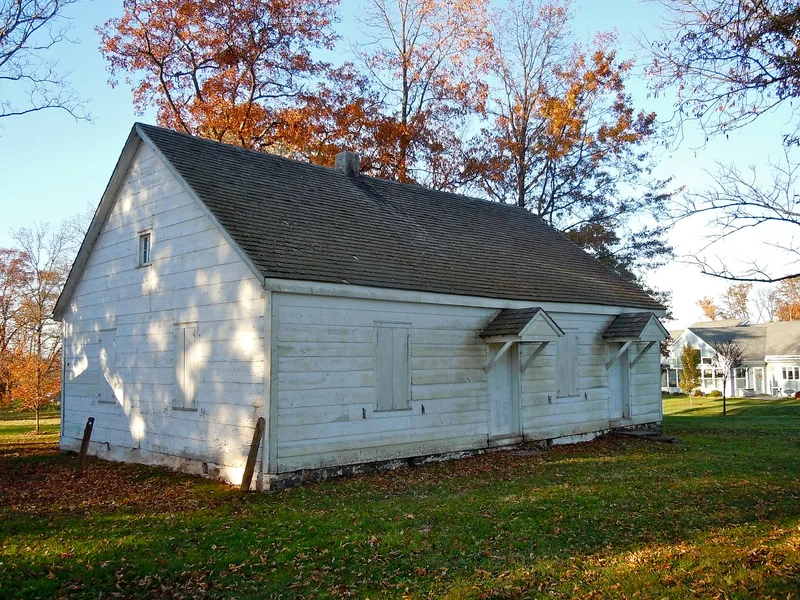
A one-story frame meetinghouse on Maple Avenue in Harleysville, Pennsylvania, Klein Meeting House was built in 1843 by the Indian Creek congregation of the Dunkards, later the Church of the Brethren. It served as a preaching place for members who lived in the outlying part of the district and could not regularly attend the main meeting, though they still travelled to Indian Creek twice yearly for communion. The building is clapboard-sheathed with a shingled roof and has two entrances in the facade, one for men and a slightly narrower one for women. Its interior has a solid turned central post, a feature common to Anabaptist meetinghouses of the period. The stone foundation incorporates fragments of marble tombstones, and the adjacent cemetery holds graves of early Dunkards, including Peter Becker. The building is listed for its association with the Anabaptist tradition and as a typical small meetinghouse of the Pennsylvania German sects.
Significance in brief: The nomination argues the meetinghouse is important to American religious history through its connection with the Anabaptist tradition, specifically the Dunkard (Brethren) congregation of Indian Creek. It is presented as a typical example of the smaller meetinghouses of Pennsylvania German sects in the nineteenth century. The adjacent cemetery is associated with early Dunkards, including Peter Becker.
Machine-generated summary. This summary was generated by a language model from the official nomination document and has not been reviewed line by line by an editor. It may contain errors. Check the source document before relying on any detail. Source: nomination document (PDF) · National Archives catalog entry. NRHP reference 73001645, listed April 13, 1973. Summary generated October 2026 (model claude-haiku-5-5, prompt v1.1-2026-10-29, confidence medium).
Key facts
| Address | Maple Ave., Harleysville |
|---|---|
| County | Montgomery County |
| Listed | April 13, 1973 |
| Reference number | 73001645 |
| Resource type | Building |
| Period of significance | 1843 |
| Criteria |
|
| Areas of significance | Architecture, Religion |
| Level of significance | State |
| Status (as stated in the nomination) | Unoccupied and in rather poor condition at the time of nomination. |
| Acreage | 2 |
| Coordinates | 40.29215, -75.37575 (NPS GIS) |
What listing means for this property
Religious properties are listed for their architectural or historical significance, not their religious use. Listing is honorary and does not restrict the congregation's use of the building. The federal rehabilitation credit is generally unavailable unless part of the building is income-producing; some state programmes and preservation grants do cover religious buildings. Federal funding or permits trigger Section 106 review.
Noted as vacant in the nomination. Nomination documents can be decades old; current status may differ. If you are considering buying an empty listed property, read the due-diligence checklist.
General information, not legal or tax advice. Rules change; confirm with your State Historic Preservation Office or a qualified adviser.
Sources and further reading
- National Park Service, National Register of Historic Places database (snapshot May 2026), reference 73001645.
- Nomination form (PDF, National Archives) — catalog entry
- Wikipedia article (used for cross-checking only; text not reproduced here)
- Wikidata Q6420164
- This listing as JSON
Last updated October 2026. Found an error? See the editorial policy for how to report it.