Jersey Shore Historic District

Why it's listed
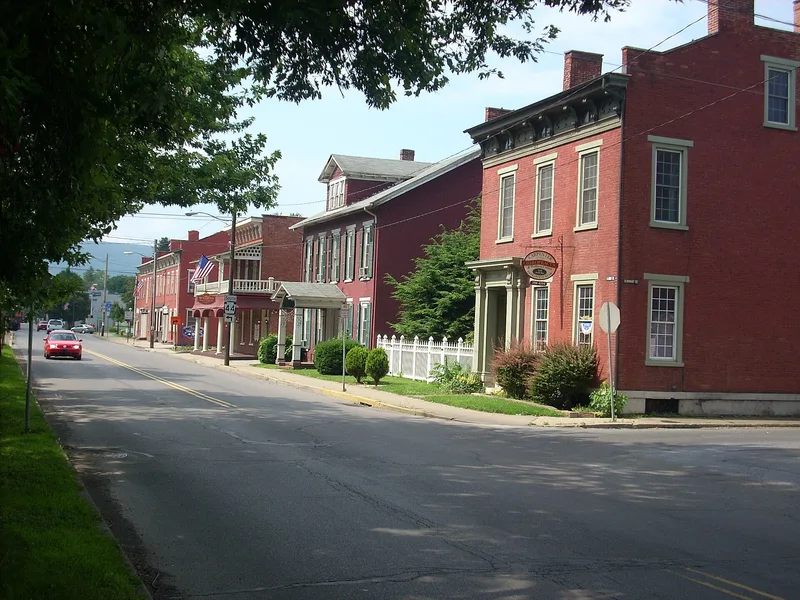
Jersey Shore is a borough on the West Branch of the Susquehanna River, and its historic district contains 336 buildings, roughly sixty of them of major architectural importance. Most were built between about 1830 and 1860, and many show Federal or Greek Revival design, with others displaying Georgian, Italianate, Gothic Revival and French Second Empire features. The town grew as a depot for the lumber regions of Pine and Larry's Creeks after the West Branch Canal passed through in 1834, and many of its houses were built for merchants and industrialists. Notable examples include the Slonaker House, a Greek temple form house with a portico of fluted Ionic columns, and the Gamble House, originally Italianate and later remodeled with Beaux-Arts Classical features. The district is valued as a cohesive example of a mid-nineteenth-century town, despite a number of later commercial intrusions.
Significance in brief: The district is significant for its concentration of Federal, Greek Revival and other 19th-century Victorian-era houses and public buildings, many associated with merchants and industrialists who lived in the town. The statement of significance says the architecture forms a cohesive district that retains much of the character of a mid-19th-century town.
Machine-generated summary. This summary was generated by a language model from the official nomination document and has not been reviewed line by line by an editor. It may contain errors. Check the source document before relying on any detail. Source: nomination document (PDF) · National Archives catalog entry. NRHP reference 75001653, listed March 31, 1975. Summary generated October 2026 (model claude-haiku-5-5, prompt v1.1-2026-10-29, confidence medium).
Key facts
| Address | Irregular shape roughly bounded by Lawshe Run, W. Branch Susquehanna River, S borough bundaries, and Tomb Ave., Jersey Shore |
|---|---|
| County | Lycoming County |
| Listed | March 31, 1975 |
| Reference number | 75001653 |
| Resource type | District |
| Period of significance | 1830-1860 |
| Architect / builder | Alexander Smith (Hume Building); John Knox (Moran-Trump House); Henry Hipple (John A. Gamble House) |
| Architectural style | Federal, Greek Revival, Georgian, Italianate, Gothic Revival, French Second Empire |
| Areas of significance | Architecture |
| Level of significance | Local |
| Status (as stated in the nomination) | Restoration activities by individual owners are underway; several intrusions are present, including commercial buildings. |
| Acreage | 150 |
| Coordinates | 41.20107, -77.25471 (NPS GIS) |
What listing means for this property
This is a historic district. Buildings within its boundary are either contributing (they add to the district's significance) or non-contributing. Owners of contributing income-producing buildings can claim the 20% federal rehabilitation tax credit; homeowners should look at state credits. National Register districts impose no design review by themselves; a local historic district ordinance, if one exists, does (the difference explained).
General information, not legal or tax advice. Rules change; confirm with your State Historic Preservation Office or a qualified adviser.
Sources and further reading
- National Park Service, National Register of Historic Places database (snapshot May 2026), reference 75001653.
- Nomination form (PDF, National Archives) — catalog entry
- Wikipedia article (used for cross-checking only; text not reproduced here)
- Wikidata Q6184936
- This listing as JSON
Last updated October 2026. Found an error? See the editorial policy for how to report it.