Troxell-Steckel House

Why it's listed
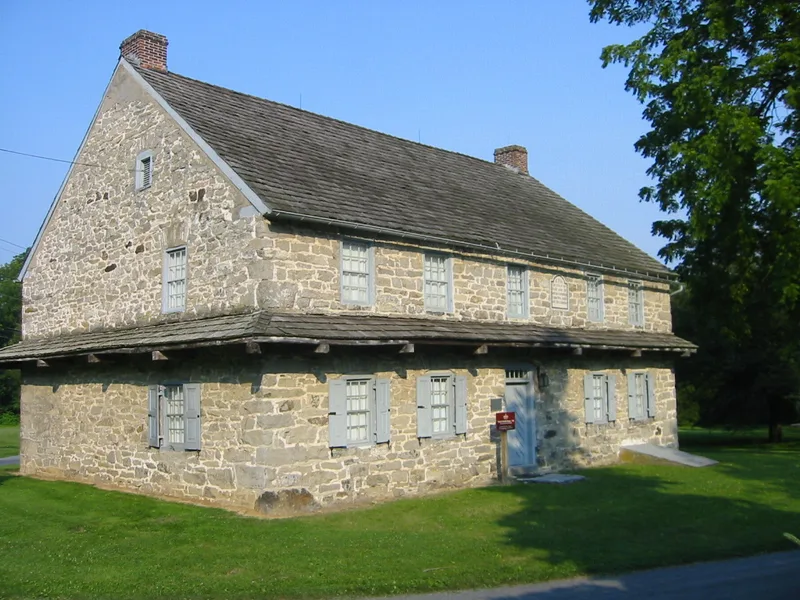
Built in 1756 by John Peter Troxell near Egypt in Lehigh County, this 2½-story fieldstone house has deep gables, arched doorways with stuccoed headers, and two large kitchen fireplaces at either end. Its interior partitions are half-timbered and filled with masonry, and the upper chambers have pine-panelled walls. The house is described as an unusual example of Pennsylvania German colonial building, comparable in construction to only a few other surviving houses in the region. Its thick walls and small, deep windows reflect an era when a dwelling also had to serve as a defensive refuge. During the 1756 Indian attacks, the militia reportedly obtained horses and a wagon from Troxell before marching to Gnadenhutten. Egypt Reformed Church services were held in the house before 1764. Peter Steckel, who bought the property in 1768, is recorded as an innovative farmer who used an Archimedes' screw to irrigate his land. The house was restored in 1943 and now serves as a museum.
Significance in brief: The nomination describes the house as an unusual example of Pennsylvania German colonial architecture, with half-timber interior partitions and thick, deep-set windows. It is also described as one of the first and largest homesteads in the upper Northampton County frontier, and as a site used for worship by the Egypt Reformed Church before the Union Church was built in 1764.
Machine-generated summary. This summary was generated by a language model from the official nomination document and has not been reviewed line by line by an editor. It may contain errors. Check the source document before relying on any detail. Source: nomination document (PDF) · National Archives catalog entry. NRHP reference 80003557, listed June 27, 1980. Summary generated October 2026 (model claude-haiku-5-5, prompt v1.1-2026-10-29, confidence medium).
Key facts
| Address | 4229 Reliance St., Egypt |
|---|---|
| County | Lehigh County |
| Listed | June 27, 1980 |
| Reference number | 80003557 |
| Resource type | Building |
| Period of significance | 1700-1799 |
| Architect / builder | Peter Troxell (builder) |
| Architectural style | Colonial Pennsylvania German |
| Areas of significance | Exploration/Settlement, Architecture |
| Level of significance | Local |
| Status (as stated in the nomination) | Restored in 1943 and presently a museum exhibiting furnishings and crafts of early settlers. |
| Acreage | 1.2 |
| Coordinates | 40.67576, -75.53516 (NPS GIS) |
What listing means for this property
National Register listing is honorary for a privately owned home: it does not by itself restrict what an owner may do with their own money, and it does not require public access. Restrictions come from local landmark or historic-district ordinances, which are separate (how they differ).
Owner-occupied houses are not eligible for the 20% federal rehabilitation tax credit, which applies to income-producing buildings, but many states offer credits for homeowners. Listing also opens the door to preservation easements and to buying a plaque. Start with what listing means for homeowners, renovating a listed house and selling one.
General information, not legal or tax advice. Rules change; confirm with your State Historic Preservation Office or a qualified adviser.
Sources and further reading
- National Park Service, National Register of Historic Places database (snapshot May 2026), reference 80003557.
- Nomination form (PDF, National Archives) — catalog entry
- Wikipedia article (used for cross-checking only; text not reproduced here)
- Wikidata Q7846704
- This listing as JSON
Last updated October 2026. Found an error? See the editorial policy for how to report it.