Cornwall Iron Furnace

Why it's listed
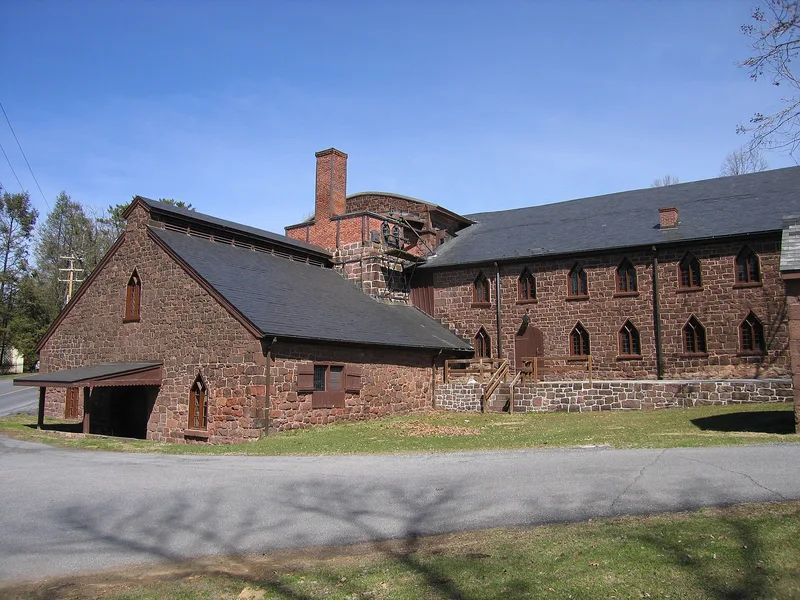
Cornwall Furnace is a charcoal iron-making complex in Lebanon County, Pennsylvania, built by Peter Grubb between 1739 and 1742 with a sandstone stack about 30 feet high. It includes the furnace, casting house, charcoal house, and water-wheel and steam-engine rooms, along with service buildings, an ironmaster's mansion, a miners' village of stone double houses, and the adjacent open-pit ore mine on Big, Middle, and Grassy Hills. The furnace produced pig iron from 1742 to 1883 and, during the Revolution, cast cannon and shot for the navy. Its ore deposit was among the largest in the country before the Lake Superior fields were developed. The complex is regarded as one of the best-preserved charcoal furnaces in the United States and illustrates how early American iron plantations were organized, with farmland, woodcutting, and worker housing supporting the furnace. Coleman family ownership from the late 1700s shaped the mansion and the later modernization of 1856-1857.
Significance in brief: The nomination argues the complex exemplifies the iron-making works that produced most of America's iron before the Civil War, and that the furnace is probably the best-preserved charcoal furnace in the United States. It also cites the Cornwall ore deposit as the largest known iron ore deposit in the country before the Lake Superior fields were developed, and the furnace's role in supplying cannon and shot during the American Revolution.
Machine-generated summary. This summary was generated by a language model from the official nomination document and has not been reviewed line by line by an editor. It may contain errors. Check the source document before relying on any detail. Source: nomination document (PDF) · National Archives catalog entry. NRHP reference 66000671, listed November 13, 1966. Summary generated October 2026 (model claude-haiku-5-5, prompt v1.1-2026-10-29, confidence medium).
Key facts
| Address | Rexmont Rd. and Boyd St., Cornwall |
|---|---|
| County | Lebanon County |
| Listed | November 13, 1966 |
| Reference number | 66000671 |
| Resource type | District |
| Period of significance | 1742-1883 |
| Areas of significance | Industry |
| Level of significance | National |
| National Historic Landmark | Yes, designated November 3, 1966 |
| Status (as stated in the nomination) | The furnace complex is maintained by the Commonwealth of Pennsylvania in excellent condition; the Manor is owned by the United Methodist Church and the miners' village houses continue to be inhabited. |
| Acreage | 175 |
| Coordinates | 40.27099, -76.40699 (NPS GIS) |
What listing means for this property
This is a historic district. Buildings within its boundary are either contributing (they add to the district's significance) or non-contributing. Owners of contributing income-producing buildings can claim the 20% federal rehabilitation tax credit; homeowners should look at state credits. National Register districts impose no design review by themselves; a local historic district ordinance, if one exists, does (the difference explained).
General information, not legal or tax advice. Rules change; confirm with your State Historic Preservation Office or a qualified adviser.
Sources and further reading
- National Park Service, National Register of Historic Places database (snapshot May 2026), reference 66000671.
- Nomination form (PDF, National Archives) — catalog entry
- Wikipedia article (used for cross-checking only; text not reproduced here)
- Wikidata Q15211708
- This listing as JSON
Last updated October 2026. Found an error? See the editorial policy for how to report it.