Bindnagles Evangelical Lutheran Church

Why it's listed
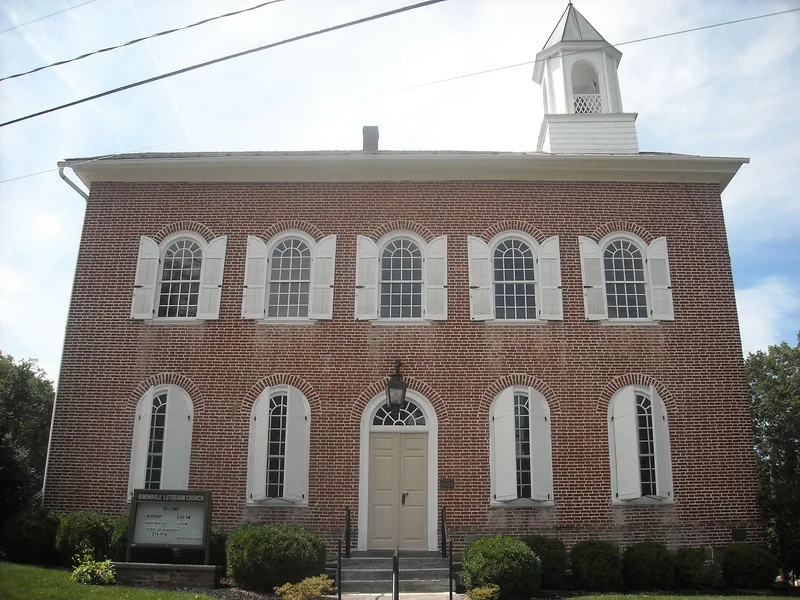
Built in 1803 of red brick with white trim, Bindnagles Evangelical Lutheran Church stands three miles north of Palmyra, Lebanon County, on land donated in 1753 by John Bindnagles. The two-story building measures 36 by 48 feet. Its bricks were made on the Peter Zimmerman farm along the Quittapahilla Creek, and the walls are thickest at the base, with a molded brick course about four feet up marking the reduction in thickness. The interior is laid out in a Greek cross plan around a Communion table, with a wineglass pulpit at the apex, high-backed pews, and a balcony on wooden Doric columns. In 1885 a Swedish immigrant, John Cardell, painted the previously unpainted interior in imitation of marble, and the work remains unchanged. The church is valued as a well-preserved late eighteenth century example of its style and as a record of early German settlers who organized congregations in the Lebanon Valley. It continues to serve an active congregation.
Significance in brief: The nomination argues the church is a well-preserved example of late eighteenth century Country Georgian architecture and a record of the religious life of early German settlers in the Lebanon Valley. Its interior, painted in imitation of marble in 1885, is described as particularly interesting and as representing elements of the Baroque Revival.
Machine-generated summary. This summary was generated by a language model from the official nomination document and has not been reviewed line by line by an editor. It may contain errors. Check the source document before relying on any detail. Source: nomination document (PDF) · National Archives catalog entry. NRHP reference 75001651, listed July 7, 1975. Summary generated October 2026 (model claude-haiku-5-5, prompt v1.1-2026-10-29, confidence medium).
Key facts
| Address | N of Palmyra at jct. of SR 38003 and SR T330, Palmyra |
|---|---|
| County | Lebanon County |
| Listed | July 7, 1975 |
| Reference number | 75001651 |
| Resource type | Building |
| Period of significance | 1803 |
| Architectural style | Country Georgian; described in the description section as Colonial architecture modeled after classic Greek design |
| Criteria |
|
| Areas of significance | Architecture, Religion |
| Level of significance | State |
| Status (as stated in the nomination) | The description states the church is serving an active congregation today and that nothing in the interior has been changed or added since 1885. |
| Acreage | 5 |
| Coordinates | 40.34406, -76.61671 (NPS GIS) |
What listing means for this property
Religious properties are listed for their architectural or historical significance, not their religious use. Listing is honorary and does not restrict the congregation's use of the building. The federal rehabilitation credit is generally unavailable unless part of the building is income-producing; some state programmes and preservation grants do cover religious buildings. Federal funding or permits trigger Section 106 review.
General information, not legal or tax advice. Rules change; confirm with your State Historic Preservation Office or a qualified adviser.
Sources and further reading
- National Park Service, National Register of Historic Places database (snapshot May 2026), reference 75001651.
- Nomination form (PDF, National Archives) — catalog entry
- Wikipedia article (used for cross-checking only; text not reproduced here)
- Wikidata Q4914033
- This listing as JSON
Last updated October 2026. Found an error? See the editorial policy for how to report it.