Robb Farm
Also known as: Robb, William Duncan, Farm; Robb, Livingston, Farm

Why it's listed
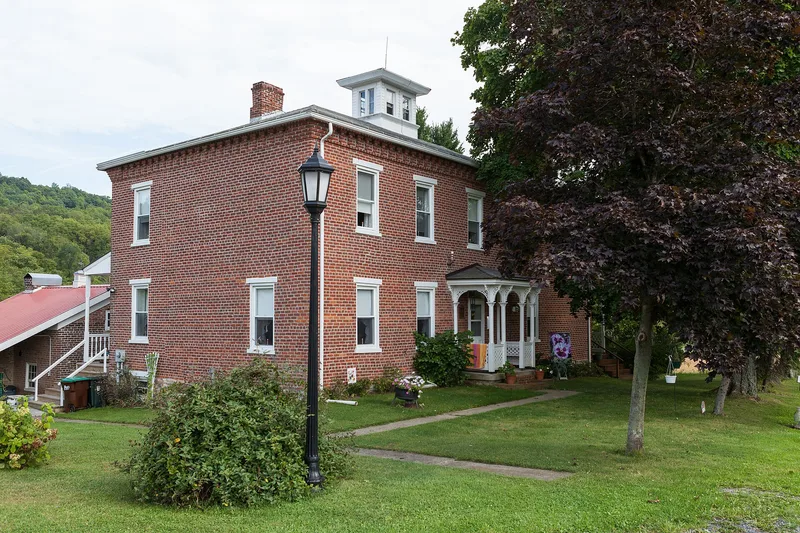
Set on a rise above Crooked Creek in the limestone Hartslog Valley, the Robb Farm is a 179-acre working farmstead whose core is a brick farmhouse begun around 1833 in the 3/5 Georgian form. William Robb, an Irish-born settler, commissioned the house after purchasing the property in 1833, and bricks were cast from creek-side clay and fired on site. The farmhouse was enlarged around 1864 by his son Livingston Robb, who reoriented the house toward the improved road and added Italianate touches. The complex includes a Pennsylvania barn dated 1839, a springhouse, a wagon shed, a milk house and a garage, eleven contributing buildings in all. The farm is regarded as a clear record of agricultural change in Huntingdon County, moving from grain and livestock to diversified market farming as canals and railroads reached the region. Its layout of fields, woodlot and house yard still reflects the 1845 subdivision. The period of significance runs from 1833 to 1959.
Significance in brief: The nomination argues the farm is significant under Criterion A for its association with the evolution of agriculture in Huntingdon County. It is presented as illustrating changing farming practices and market orientation from the 1830s through the mid-twentieth century, and as meeting or exceeding township averages over time. The period of significance runs from 1833 to 1959.
Machine-generated summary. This summary was generated by a language model from the official nomination document and has not been reviewed line by line by an editor. It may contain errors. Check the source document before relying on any detail. Source: nomination document (PDF) · National Archives catalog entry. NRHP reference 11000202, listed April 20, 2011. Summary generated October 2026 (model claude-haiku-5-5, prompt v1.1-2026-10-29, confidence medium).
Key facts
| Address | 11023 Hartslog Valley Rd (SR 3039), Walker Township |
|---|---|
| County | Huntingdon County |
| Listed | April 20, 2011 |
| Reference number | 11000202 |
| Resource type | Building |
| Period of significance | 1833-1959 |
| Architectural style | Colonial / Georgian; Early Republic / Federal; Late Victorian / Italianate |
| Criteria |
|
| Areas of significance | Agriculture |
| Level of significance | Local |
| Status (as stated in the nomination) | The house is described as having been re-pointed and sandblasted around 1985 and having a forced hot air furnace added about 1985; the document does not state a current use. |
| Acreage | 179.7 |
| Coordinates | 40.48668, -78.09436 (NPS GIS) |
What listing means for this property
National Register listing is honorary for a privately owned home: it does not by itself restrict what an owner may do with their own money, and it does not require public access. Restrictions come from local landmark or historic-district ordinances, which are separate (how they differ).
Owner-occupied houses are not eligible for the 20% federal rehabilitation tax credit, which applies to income-producing buildings, but many states offer credits for homeowners. Listing also opens the door to preservation easements and to buying a plaque. Start with what listing means for homeowners, renovating a listed house and selling one.
General information, not legal or tax advice. Rules change; confirm with your State Historic Preservation Office or a qualified adviser.
Sources and further reading
- National Park Service, National Register of Historic Places database (snapshot May 2026), reference 11000202.
- Nomination form (PDF, National Archives) — catalog entry
- Wikipedia article (used for cross-checking only; text not reproduced here)
- Wikidata Q7340772
- This listing as JSON
Last updated October 2026. Found an error? See the editorial policy for how to report it.