Waynesburg Historic District
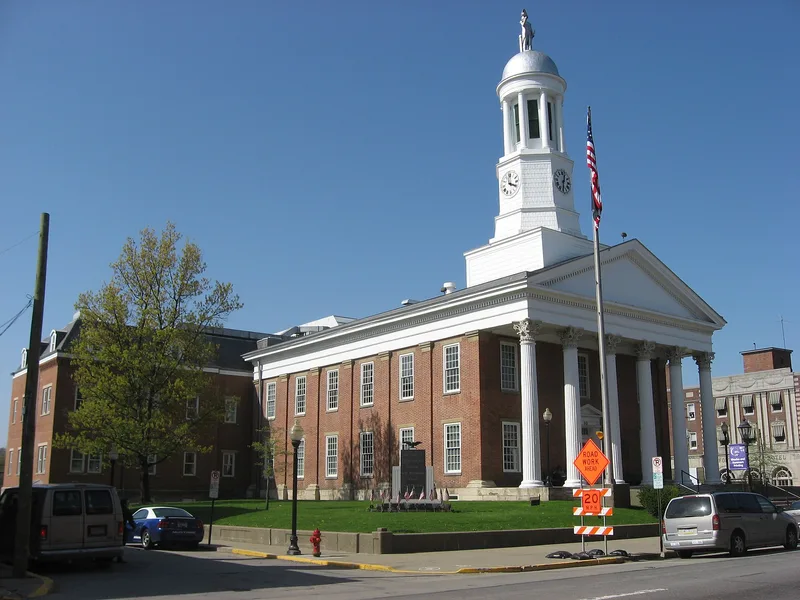

Why it's listed
Laid out in a grid of north-south and east-west streets, Waynesburg is a county seat whose central district holds 224 structures, most of them brick with wood-joist floors and roofs. Its residential blocks are largely late nineteenth century, with vernacular Queen Anne as the most common style, joined by Second Empire, Stick and Georgian Revival houses. Many are two-story dwellings on raised sandstone bases, with porches and gable roofs, and a few retain original multicolored slate. Along High Street, commercial buildings range from early Federal and Greek Revival fronts built between 1850 and 1880 to Italianate and early twentieth century Neo-Classical blocks. The town became the county seat in 1796 and gained commercial importance from wool production and natural gas drilling in the later nineteenth century. Waynesburg College, founded by the Cumberland Presbyterian Church and opened in 1851, anchors the north end, with Miller Hall, a four-story Second Empire building, as its most prominent structure.
Significance in brief: The district is significant for its concentration of late nineteenth century architecture, which the nomination describes as one of the better preserved groupings in western Pennsylvania and an insight into regional architectural evolution. It is also tied to the town's role as county seat, the local wool industry and natural gas discoveries that boosted commerce between 1860 and 1900, and the growth of Waynesburg College.
Machine-generated summary. This summary was generated by a language model from the official nomination document and has not been reviewed line by line by an editor. It may contain errors. Check the source document before relying on any detail. Source: nomination document (PDF) · National Archives catalog entry. NRHP reference 84003392, listed March 1, 1984. Summary generated October 2026 (model claude-haiku-5-5, prompt v1.1-2026-10-29, confidence medium).
Key facts
| Address | Roughly bounded by 2nd Alley, Cherry Ave., East and Bowlby Sts., Waynesburg |
|---|---|
| County | Greene County |
| Listed | March 1, 1984 |
| Reference number | 84003392 |
| Resource type | District |
| Period of significance | 1800-1899 |
| Architectural style | Queen Anne, Second Empire, Stick, Georgian Revival, Federal, Greek Revival, Italianate, Neo-Classical, Gothic Revival |
| Criteria |
|
| Areas of significance | Commerce, Architecture |
| Level of significance | Local |
| Status (as stated in the nomination) | The majority of buildings are described as in very good condition and retaining a high degree of integrity. |
| Acreage | 61.4 |
| Coordinates | 39.89815, -80.18635 (NPS GIS) |
What listing means for this property
This is a historic district. Buildings within its boundary are either contributing (they add to the district's significance) or non-contributing. Owners of contributing income-producing buildings can claim the 20% federal rehabilitation tax credit; homeowners should look at state credits. National Register districts impose no design review by themselves; a local historic district ordinance, if one exists, does (the difference explained).
General information, not legal or tax advice. Rules change; confirm with your State Historic Preservation Office or a qualified adviser.
Sources and further reading
- National Park Service, National Register of Historic Places database (snapshot May 2026), reference 84003392.
- Nomination form (PDF, National Archives) — catalog entry
- Wikipedia article (used for cross-checking only; text not reproduced here)
- Wikidata Q7976818
- This listing as JSON
Last updated October 2026. Found an error? See the editorial policy for how to report it.