Gordon, George W., Farm

Why it's listed
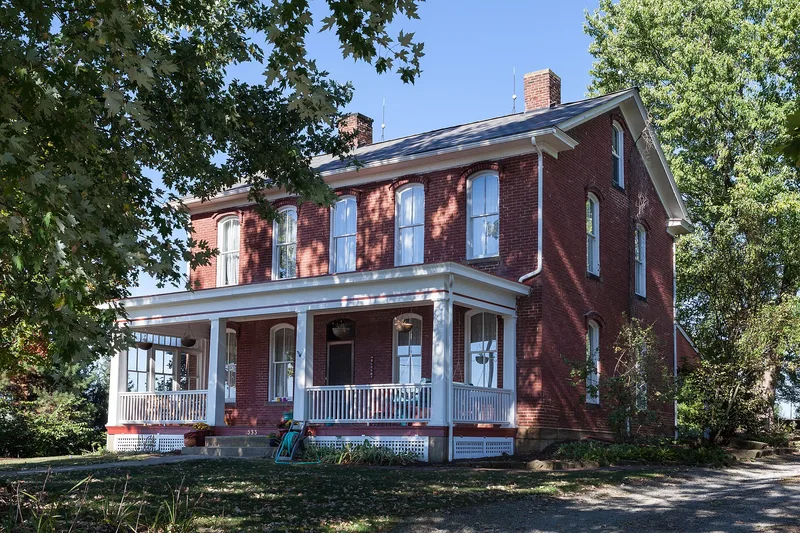
Built in brick around 1879 in the hills of Greene County, Pennsylvania, the George W. Gordon Farm combines a two-story, five-bay Italianate farmhouse with a barn, stable, wash house and several pegged timber field buildings, all dating from about 1880. The house sits on a ridge with a view over the sloped fields, which were laid out for raising sheep. Its segmentally arched windows, drip mouldings and cast iron mantelpieces are typical of the style in the region. The farm reflects the regional boom in stock sheep raising in the late nineteenth century, when Greene and Washington Counties led the state in sheep numbers. After the Gordons sold the property, it shifted toward cattle and dairy farming, and the buildings and field arrangement still show both phases. George W. Gordon was a banker who inherited the land from his father and ran the farm as a stock operation. The farm is listed for its agricultural layout and for its architecture.
Significance in brief: The nomination argues the farm is a good example of the stock-sheep farming that dominated Greene and Washington Counties in the late nineteenth century, with its layout of scattered field sheds and hilltop house. The house is argued to be an Italianate variation on the regional five-bay, center passage farmhouse, with interior and exterior details typical of the style.
Machine-generated summary. This summary was generated by a language model from the official nomination document and has not been reviewed line by line by an editor. It may contain errors. Check the source document before relying on any detail. Source: nomination document (PDF) · National Archives catalog entry. NRHP reference 00000965, listed August 24, 2000. Summary generated October 2026 (model claude-haiku-5-5, prompt v1.1-2026-10-29, confidence medium).
Key facts
| Address | 333 Mary Hoge Rd., 0.3 mi. SW of Gordon Hill, Franklin |
|---|---|
| County | Greene County |
| Listed | August 24, 2000 |
| Reference number | 00000965 |
| Resource type | Building |
| Period of significance | 1879-1949 |
| Architectural style | Italianate |
| Criteria |
|
| Areas of significance | Agriculture, Architecture |
| Level of significance | Local |
| Status (as stated in the nomination) | The fields are actively farmed and the chicken coop is non-contributing; a wagon shed dates to about 1930 and the property was later purchased as a residence. |
| Acreage | 252 |
| Coordinates | 39.84785, -80.15665 (NPS GIS) |
What listing means for this property
National Register listing is honorary for a privately owned home: it does not by itself restrict what an owner may do with their own money, and it does not require public access. Restrictions come from local landmark or historic-district ordinances, which are separate (how they differ).
Owner-occupied houses are not eligible for the 20% federal rehabilitation tax credit, which applies to income-producing buildings, but many states offer credits for homeowners. Listing also opens the door to preservation easements and to buying a plaque. Start with what listing means for homeowners, renovating a listed house and selling one.
General information, not legal or tax advice. Rules change; confirm with your State Historic Preservation Office or a qualified adviser.
Sources and further reading
- National Park Service, National Register of Historic Places database (snapshot May 2026), reference 00000965.
- Nomination form (PDF, National Archives) — catalog entry
- Wikipedia article (used for cross-checking only; text not reproduced here)
- Wikidata Q5546170
- This listing as JSON
Last updated October 2026. Found an error? See the editorial policy for how to report it.