McConnellsburg Historic District
Also known as: See Also: Fulton House; McConnell House

Why it's listed
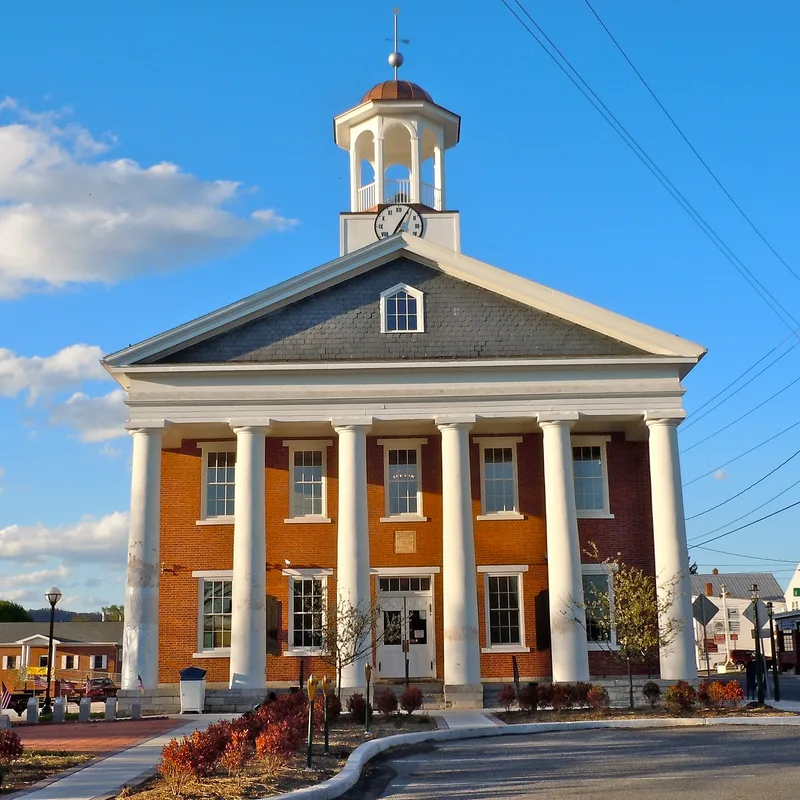
Along Lincoln Way in McConnellsburg, the county seat of Fulton County, a district of roughly 158 buildings records a town shaped by the road that ran from Philadelphia to Pittsburgh. Daniel McConnell operated an inn on the packhorse route by 1765, and the town was laid out in 1786. Its taverns, inns and blacksmith shops served travellers, and an 1835 tax list shows 46 of 107 listed occupations tied to the turnpike. Buildings range from the late 18th century into the 1940s, including Georgian houses of the 1790s, the Fulton House inn dating from 1793, and the Greek Revival courthouse built in 1852 after the county was created in 1850. Early 20th century automobile garages mark the road's later life as the Lincoln Highway. Thirteen of the buildings are non-contributing, mostly post-1950 infill.
Significance in brief: The nomination argues the district is significant for its role as a stopping place on the Philadelphia to Pittsburgh turnpike, later the Lincoln Highway, and for the travel-related inns, taverns and automobile garages that reflect it. It also cites the town's status as county seat since 1850, marked by the Greek Revival courthouse, and its comprehensive range of residential, commercial and governmental architecture in the county.
Machine-generated summary. This summary was generated by a language model from the official nomination document and has not been reviewed line by line by an editor. It may contain errors. Check the source document before relying on any detail. Source: nomination document (PDF) · National Archives catalog entry. NRHP reference 93000727, listed August 9, 1993. Summary generated October 2026 (model claude-haiku-5-5, prompt v1.1-2026-10-29, confidence medium).
Key facts
| Address | Roughly, Lincoln Way from First St. to Fifth Ave. and Second St. from Spruce St. to Maple St., McConnellsburg |
|---|---|
| County | Fulton County |
| Listed | August 9, 1993 |
| Reference number | 93000727 |
| Resource type | District |
| Period of significance | Ca. 1762-1940 |
| Architectural style | Georgian, Federal, Greek Revival, Italianate, Second Empire, Queen Anne, American Four Square, Colonial Revival, Bungalow |
| Criteria |
|
| Areas of significance | Transportation, Politics/Government, Architecture |
| Level of significance | Local |
| Status (as stated in the nomination) | Buildings are described as generally in good to excellent condition, with 13 of about 158 buildings non-contributing. |
| Acreage | 25 |
| Coordinates | 39.93239, -77.99873 (NPS GIS) |
What listing means for this property
This is a historic district. Buildings within its boundary are either contributing (they add to the district's significance) or non-contributing. Owners of contributing income-producing buildings can claim the 20% federal rehabilitation tax credit; homeowners should look at state credits. National Register districts impose no design review by themselves; a local historic district ordinance, if one exists, does (the difference explained).
General information, not legal or tax advice. Rules change; confirm with your State Historic Preservation Office or a qualified adviser.
Sources and further reading
- National Park Service, National Register of Historic Places database (snapshot May 2026), reference 93000727.
- Nomination form (PDF, National Archives) — catalog entry
- Wikipedia article (used for cross-checking only; text not reproduced here)
- Wikidata Q15252520
- This listing as JSON
Last updated October 2026. Found an error? See the editorial policy for how to report it.