Monterey Historic District

Why it's listed
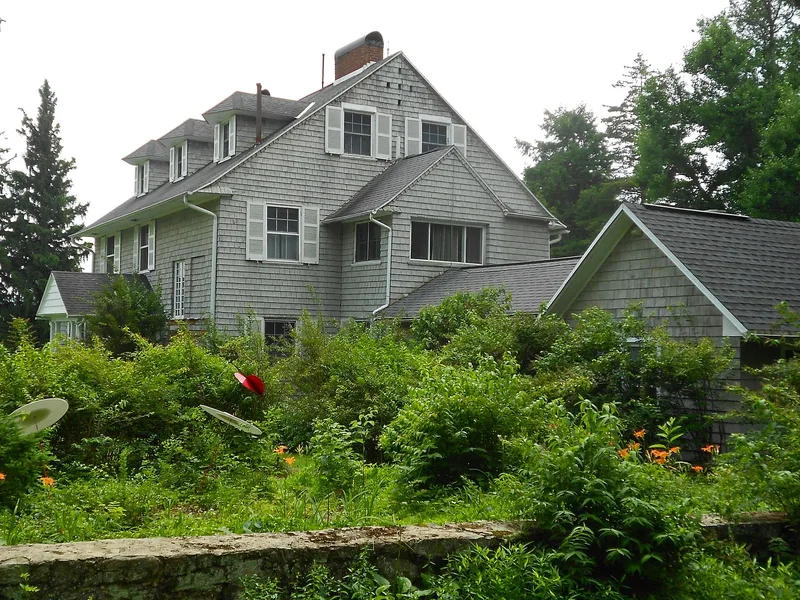
Blue Ridge Summit's Monterey district is a cluster of late nineteenth-century summer houses, inns, a church, a library, a club and a golf course laid out along Charmian Road, Charmian Lane, Clermont Avenue and Monterey Circle. The area grew from an inn or way station at the junction of Charmian Road and Monterey Lane, which dates to 1810 and sat on the old Baltimore-Pittsburgh turnpike. After the Monterey Land Company bought the Monterey Springs farm in 1885, it created a planned summer colony with winding lanes, low stone walls, and houses sited for mountain views. Its covenants banned alcohol outside the inn properties and prohibited detached privies, stores, factories and dwellings costing less than $2,000. Houses built between 1890 and 1906 show Queen Anne, Georgian Revival, Shingle and Italianate forms. The district is significant as an intact example of a Victorian resort community, shaped by the railroad excursion trade.
Significance in brief: The nomination argues the district is a fine example of a 19th-century summer resort community that retains the character of the Victorian era. Its planned layout by the Monterey Land Company, its links to the Monterey Inn and the Western Maryland Railroad's resort trade, and its varied architecture from the 1880s to about 1906 are cited as the basis for significance.
Machine-generated summary. This summary was generated by a language model from the official nomination document and has not been reviewed line by line by an editor. It may contain errors. Check the source document before relying on any detail. Source: nomination document (PDF) · National Archives catalog entry. NRHP reference 76001639, listed April 22, 1976. Summary generated October 2026 (model claude-haiku-5-5, prompt v1.1-2026-10-29, confidence medium).
Key facts
| Address | Off PA 16, Blue Ridge Summit |
|---|---|
| County | Franklin County |
| Listed | April 22, 1976 |
| Reference number | 76001639 |
| Resource type | District |
| Period of significance | 1800-1899 |
| Architectural style | Queen Anne, Georgian Revival, Shingle style, Italianate and other styles, described as transitional |
| Criteria |
|
| Areas of significance | Community Planning and Development, Entertainment/Recreation, Architecture |
| Level of significance | State |
| Status (as stated in the nomination) | Most of the district is intact; the Monterey Inn burned in 1941, the Clermont was razed, and the Dunbrack Library and Dunbrack Inn are no longer in use. |
| Acreage | 250 |
| Coordinates | 39.73621, -77.46898 (NPS GIS) |
What listing means for this property
This is a historic district. Buildings within its boundary are either contributing (they add to the district's significance) or non-contributing. Owners of contributing income-producing buildings can claim the 20% federal rehabilitation tax credit; homeowners should look at state credits. National Register districts impose no design review by themselves; a local historic district ordinance, if one exists, does (the difference explained).
General information, not legal or tax advice. Rules change; confirm with your State Historic Preservation Office or a qualified adviser.
Sources and further reading
- National Park Service, National Register of Historic Places database (snapshot May 2026), reference 76001639.
- Nomination form (PDF, National Archives) — catalog entry
- Wikipedia article (used for cross-checking only; text not reproduced here)
- Wikidata Q6905319
- This listing as JSON
Last updated October 2026. Found an error? See the editorial policy for how to report it.