McCoy-Shoemaker Farm

Why it's listed
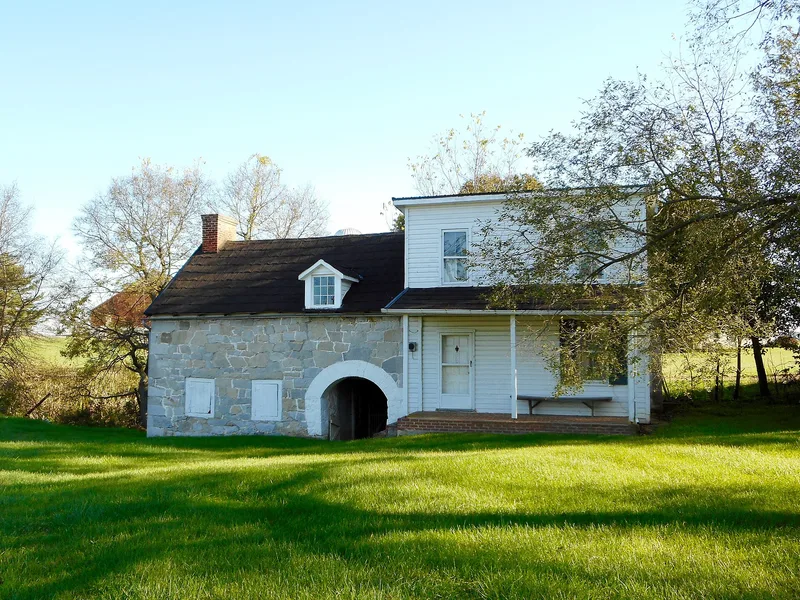
Set on the east side of State Route 995 a short distance southwest of Upton, the farmstead holds a brick house probably dating from the 1820s or 1830s, laid in Flemish bond at the front with narrow, trowel-struck mortar joints. Its interior retains late federal woodwork, including a central stair, turned newel and carved mantelpieces. Beside it stands a stone springhouse and dwelling, apparently built about 1800, with a spring running through its ground-level passage and a plastered upper room. A large stone end bank barn, a frame wash house with a brick oven, a stone smoke house and a brick privy complete the group. Together the buildings are considered a rare, complete collection of typical outbuildings needed on a farm where food was grown and processed for family use, and they remain in excellent condition with few alterations. The farm's long family ownership adds to its importance.
Significance in brief: The nomination argues the complex is a complete group of rural farm buildings reflecting 19th-century farm life, and that the buildings are important vernacular examples of stone and brick construction in Pennsylvania. The property is also significant for its continuous ownership by only two families, the McCoy family from 1743 to 1857 and the Shoemaker family from 1864 onward. The main house's woodwork reflects the late federal period.
Machine-generated summary. This summary was generated by a language model from the official nomination document and has not been reviewed line by line by an editor. It may contain errors. Check the source document before relying on any detail. Source: nomination document (PDF) · National Archives catalog entry. NRHP reference 80003500, listed June 27, 1980. Summary generated October 2026 (model claude-haiku-5-5, prompt v1.1-2026-10-29, confidence high).
Key facts
| Address | SW of Upton on PA 995, Upton |
|---|---|
| County | Franklin County |
| Listed | June 27, 1980 |
| Reference number | 80003500 |
| Resource type | Building |
| Period of significance | 1800-1899 |
| Architectural style | Vernacular; late federal period woodwork |
| Areas of significance | Architecture, Agriculture |
| Level of significance | Local |
| Status (as stated in the nomination) | The buildings are described as being in excellent condition. |
| Acreage | 5 |
| Coordinates | 39.79918, -77.82203 (NPS GIS) |
What listing means for this property
National Register listing is honorary for a privately owned home: it does not by itself restrict what an owner may do with their own money, and it does not require public access. Restrictions come from local landmark or historic-district ordinances, which are separate (how they differ).
Owner-occupied houses are not eligible for the 20% federal rehabilitation tax credit, which applies to income-producing buildings, but many states offer credits for homeowners. Listing also opens the door to preservation easements and to buying a plaque. Start with what listing means for homeowners, renovating a listed house and selling one.
General information, not legal or tax advice. Rules change; confirm with your State Historic Preservation Office or a qualified adviser.
Sources and further reading
- National Park Service, National Register of Historic Places database (snapshot May 2026), reference 80003500.
- Nomination form (PDF, National Archives) — catalog entry
- Wikipedia article (used for cross-checking only; text not reproduced here)
- Wikidata Q6800626
- This listing as JSON
Last updated October 2026. Found an error? See the editorial policy for how to report it.