Burns, Jeremiah, Farm
Also known as: Burns Place

Why it's listed
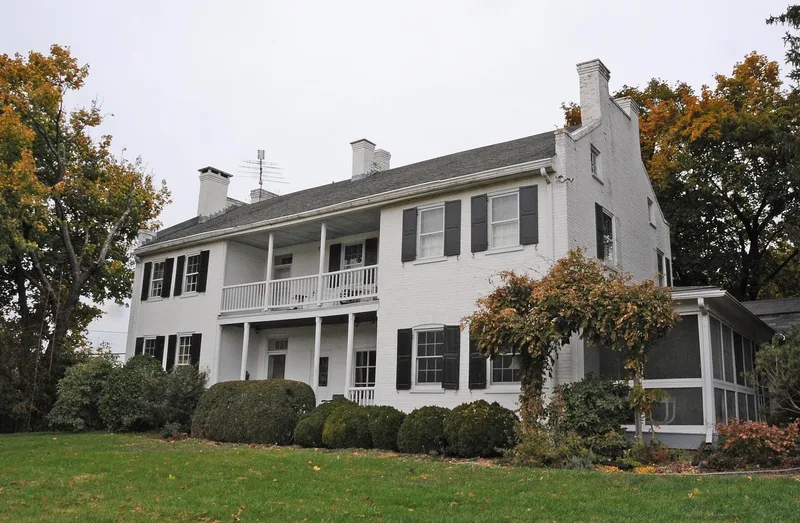
Built in 1832 by Jeremiah Burns on land first settled by his family in 1774, this two-story, seven-bay brick farmhouse sits on a farm in the Roadside area near the East Branch of Little Antietam Creek. Its central three-bay recessed double porch and symmetrical facade reflect Greek Revival taste adapted to local farmhouse traditions, and its interior retains a central passage plan, original staircase and six-panel doors. Beside it stands a frame bank barn dating to about 1900, which keeps its open forebay and original animal stalls. The property records the farm's grain and livestock production from the 1830s into the mid-twentieth century, when many neighboring farms converted to dairy. Remnants of an earlier mill complex, including a sickle mill foundation, a raceway and a line of cobblestones, lie along the southern boundary. The farm remains in agricultural use today.
Significance in brief: The farm is significant under Criterion A for its association with agricultural development in the Roadside area from 1832 through 1950, and under Criterion C for the architecture of the farmhouse, described as an intact rural adaptation of the Greek Revival style, and the barn, described as a remarkably intact Pennsylvania style barn with an open forebay and original stalls. The Burns family also operated a small 18th and 19th century industrial complex on the property.
Machine-generated summary. This summary was generated by a language model from the official nomination document and has not been reviewed line by line by an editor. It may contain errors. Check the source document before relying on any detail. Source: nomination document (PDF) · National Archives catalog entry. NRHP reference 02000065, listed August 15, 2002. Summary generated October 2026 (model claude-haiku-5-5, prompt v1.1-2026-10-29, confidence medium).
Key facts
| Address | 10988 Fish and Game Rd., Waynesboro |
|---|---|
| County | Franklin County |
| Listed | August 15, 2002 |
| Reference number | 02000065 |
| Resource type | Building |
| Period of significance | c. 1774-1950 |
| Architectural style | Mid 19th century vernacular with Greek Revival influence; Pennsylvania barn |
| Criteria |
|
| Areas of significance | Agriculture, Architecture, Industry |
| Level of significance | Local |
| Status (as stated in the nomination) | The farm continues under cultivation, with about 69 acres in agricultural production and sheep occupying the barn. |
| Coordinates | 39.76720, -77.52726 (NPS GIS) |
What listing means for this property
National Register listing is honorary for a privately owned home: it does not by itself restrict what an owner may do with their own money, and it does not require public access. Restrictions come from local landmark or historic-district ordinances, which are separate (how they differ).
Owner-occupied houses are not eligible for the 20% federal rehabilitation tax credit, which applies to income-producing buildings, but many states offer credits for homeowners. Listing also opens the door to preservation easements and to buying a plaque. Start with what listing means for homeowners, renovating a listed house and selling one.
General information, not legal or tax advice. Rules change; confirm with your State Historic Preservation Office or a qualified adviser.
Sources and further reading
- National Park Service, National Register of Historic Places database (snapshot May 2026), reference 02000065.
- Nomination form (PDF, National Archives) — catalog entry
- Wikipedia article (used for cross-checking only; text not reproduced here)
- Wikidata Q6180753
- This listing as JSON
Last updated October 2026. Found an error? See the editorial policy for how to report it.