Thompson Cottage
Also known as: James Marshall Cottage

Why it's listed
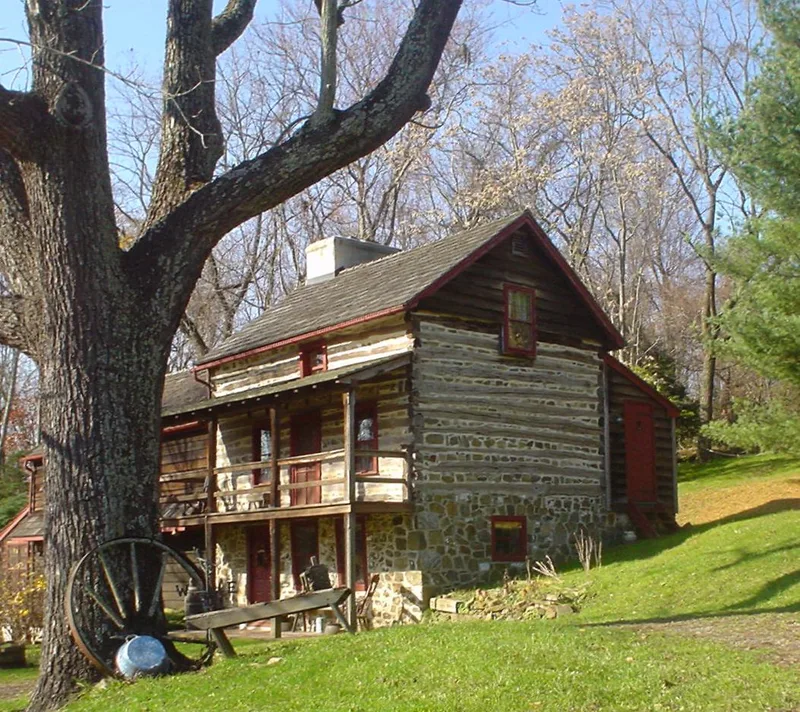
Built in the 18th century as a stone and log cottage on a small tract in Concord Township, the house was originally constructed by James Marshall, a landowner of considerable property. Its stone first story, log upper walls, and cantilevered beams that mark a former porch remain largely intact, with few later alterations. The log portion was clapboarded around 1870, and the interior retains beaded vertical board partitions, an original wall cupboard with glass doors, and early hardware on the doors. The nomination regards it as a typical modest farmhouse of tenant farmers rather than a manor house of wealthy landowners. It is significant for its rare survival of an unaltered 18th century log cabin in Southeastern Pennsylvania and for its association with Thomas Thompson, a free Black man who purchased the house and about two acres in 1847, and his descendants, who owned and occupied it for well over a century.
Significance in brief: The nomination describes it as one of very few completely unaltered 18th century log cabins in Southeastern Pennsylvania and an example of a simple tenant farmhouse. It is also associated with Thomas Thompson, a free Black man who bought the property in 1847, and his family, who owned it for a long period, which the nomination calls the only instance of a Black family owning land in the township for so long.
Machine-generated summary. This summary was generated by a language model from the official nomination document and has not been reviewed line by line by an editor. It may contain errors. Check the source document before relying on any detail. Source: nomination document (PDF) · National Archives catalog entry. NRHP reference 77001166, listed April 13, 1977. Summary generated October 2026 (model claude-haiku-5-5, prompt v1.1-2026-10-29, confidence medium).
Key facts
| Address | SE of Westchester on Thornton Rd., Westchester |
|---|---|
| County | Delaware County |
| Listed | April 13, 1977 |
| Reference number | 77001166 |
| Resource type | Building |
| Period of significance | 1600-1699 |
| Architect / builder | James Marshall |
| Areas of significance | Black, Architecture |
| Level of significance | Local |
| Status (as stated in the nomination) | Unoccupied and in disrepair, though structurally sound; the nomination says it could be accurately restored. |
| Acreage | 1 |
| Coordinates | 39.89399, -75.52296 (NPS GIS) |
What listing means for this property
National Register listing is honorary for a privately owned home: it does not by itself restrict what an owner may do with their own money, and it does not require public access. Restrictions come from local landmark or historic-district ordinances, which are separate (how they differ).
Owner-occupied houses are not eligible for the 20% federal rehabilitation tax credit, which applies to income-producing buildings, but many states offer credits for homeowners. Listing also opens the door to preservation easements and to buying a plaque. Start with what listing means for homeowners, renovating a listed house and selling one.
Noted as vacant in the nomination. Nomination documents can be decades old; current status may differ. If you are considering buying an empty listed property, read the due-diligence checklist.
General information, not legal or tax advice. Rules change; confirm with your State Historic Preservation Office or a qualified adviser.
Sources and further reading
- National Park Service, National Register of Historic Places database (snapshot May 2026), reference 77001166.
- Nomination form (PDF, National Archives) — catalog entry
- Wikipedia article (used for cross-checking only; text not reproduced here)
- Wikidata Q7795713
- This listing as JSON
Last updated October 2026. Found an error? See the editorial policy for how to report it.