Peace Church
Also known as: Friedens Kierche

Why it's listed
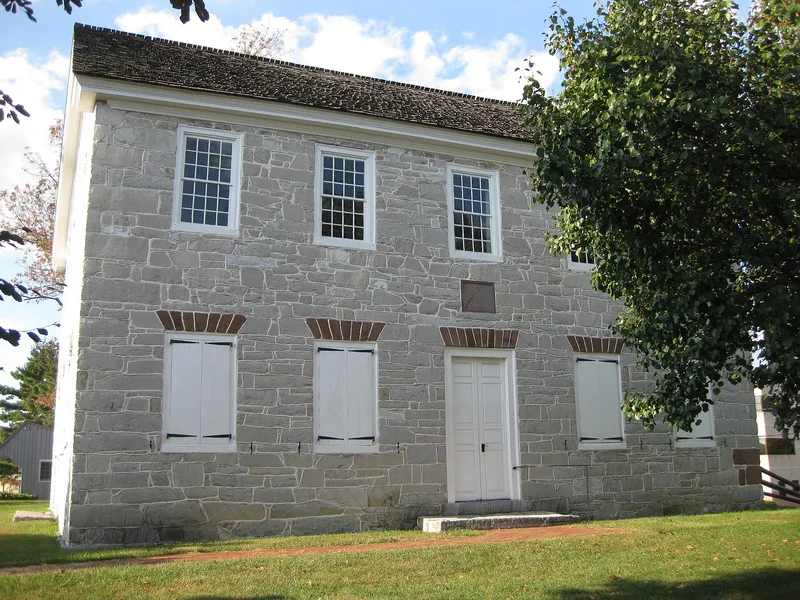
Built of limestone in Camp Hill, Cumberland County, Peace Church had its cornerstone laid on 12 June 1798, and the building was completed in the spring of 1799. Thomas Anderson, a mason, and Martin Rupp, a carpenter, constructed it. The church served the early Reformed and Lutheran congregations of Cumberland County and was the mother church for all churches in the Harrisburg-West Shore area. Its interior keeps a wine glass pulpit with a sounding board, a secondary pulpit, straight-back pews, a brick floor in the pew area, and a balcony on three sides. The balcony holds a pipe organ built in 1807 by Conrad Doll of Lancaster, which is among the oldest pipe organs still in use in any American church. The church is regarded as a typical example of Pennsylvania churches of the late eighteenth century, and it is valued because it has remained completely unaltered since its construction.
Significance in brief: The nomination argues the church is a typical example of Pennsylvania churches of the last decade of the eighteenth century and that it has remained completely unaltered. It also highlights its 1807 pipe organ, described as one of the oldest pipe organs still in use in any church in America, and its role as mother church for early Reformed and Lutheran congregations in the Harrisburg-West Shore area.
Machine-generated summary. This summary was generated by a language model from the official nomination document and has not been reviewed line by line by an editor. It may contain errors. Check the source document before relying on any detail. Source: nomination document (PDF) · National Archives catalog entry. NRHP reference 72001114, listed March 24, 1972. Summary generated October 2026 (model claude-haiku-5-5, prompt v1.1-2026-10-29, confidence medium).
Key facts
| Address | NW corner of Trindle and St. John's Rds., Camp Hill |
|---|---|
| County | Cumberland County |
| Listed | March 24, 1972 |
| Reference number | 72001114 |
| Resource type | Building |
| Period of significance | 1798-1799 |
| Architect / builder | Thomas Anderson (mason); Martin Rupp (carpenter) |
| Areas of significance | Architecture, Religion |
| Level of significance | State |
| Status (as stated in the nomination) | Unaltered, original site |
| Acreage | 1 |
| Coordinates | 40.23175, -76.95665 (NPS GIS) |
What listing means for this property
Religious properties are listed for their architectural or historical significance, not their religious use. Listing is honorary and does not restrict the congregation's use of the building. The federal rehabilitation credit is generally unavailable unless part of the building is income-producing; some state programmes and preservation grants do cover religious buildings. Federal funding or permits trigger Section 106 review.
General information, not legal or tax advice. Rules change; confirm with your State Historic Preservation Office or a qualified adviser.
Sources and further reading
- National Park Service, National Register of Historic Places database (snapshot May 2026), reference 72001114.
- Nomination form (PDF, National Archives) — catalog entry
- Wikipedia article (used for cross-checking only; text not reproduced here)
- Wikidata Q7157346
- This listing as JSON
Last updated October 2026. Found an error? See the editorial policy for how to report it.