Titusville Historic District

Why it's listed
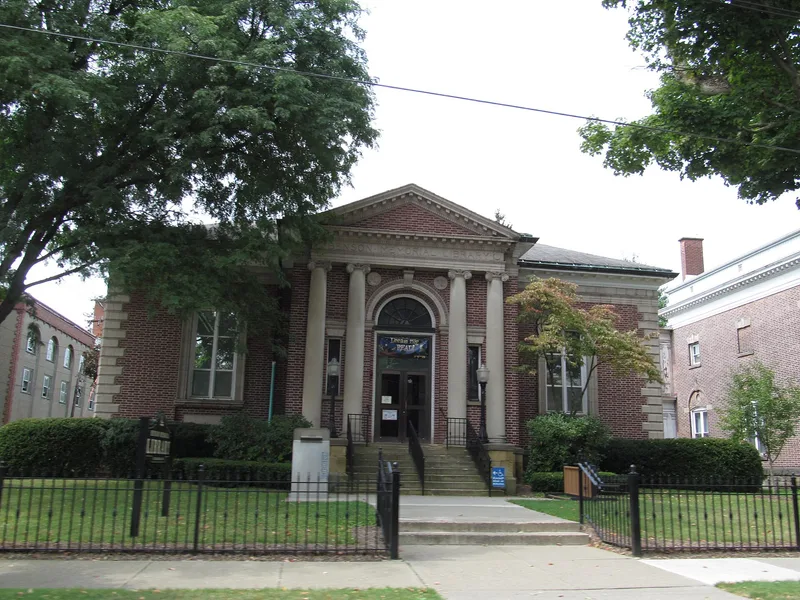
Titusville's historic district covers about 170 acres of level, grid-planned ground in the northcentral part of the city, and holds 503 structures, 472 of them contributing. Its growth follows the oil industry that began after Edwin L. Drake's successful well in August 1859. Before that, the town was a lumber center on Oil Creek, and a few pre-1859 buildings survive, including the William Barnsdall House, built about 1855 in a vernacular version of Greek Revival. Frame houses dominated the first boom years, and by the mid-1860s brick commercial buildings, the first brick church and the first brick residence had appeared. Downtown blocks are mostly Italianate, with later commercial work in Neo-Classical, Beaux Arts and Second Empire forms. Residential streets hold single-family houses on lots of about 9,225 square feet, many shaded by large maples. The district is significant as the surviving core of the town's commercial, cultural and residential buildings from the boom years and the early 1900s.
Significance in brief: The district is significant as the core of Titusville's commercial, cultural and major residential buildings, reflecting the town's development as a lumber center and then as a regional industrial and commercial center during the oil boom that followed Drake's 1859 well. The nomination notes that its buildings display a wide range of American architectural styles from the late nineteenth and early twentieth centuries, and that it remains largely unaltered.
Machine-generated summary. This summary was generated by a language model from the official nomination document and has not been reviewed line by line by an editor. It may contain errors. Check the source document before relying on any detail. Source: nomination document (PDF) · National Archives catalog entry. NRHP reference 85000178, listed January 31, 1985. Summary generated October 2026 (model claude-haiku-5-5, prompt v1.1-2026-10-29, confidence medium).
Key facts
| Address | Roughly bounded by Petroleum, Spruce, Franklin, Perry, Monroe, Main and Spring Sts., Titusville |
|---|---|
| County | Crawford County |
| Listed | January 31, 1985 |
| Reference number | 85000178 |
| Resource type | District |
| Period of significance | 1859-1900 |
| Architectural style | Italianate, Greek Revival, Second Empire, Queen Anne, Colonial Revival, Richardsonian Romanesque and other late Victorian and early twentieth-century styles |
| Criteria |
|
| Areas of significance | Industry, Commerce |
| Level of significance | Local |
| Status (as stated in the nomination) | The district is described as primarily unaltered, with 31 intrusive structures. |
| Acreage | 170 |
| Coordinates | 41.63118, -79.67606 (NPS GIS) |
What listing means for this property
This is a historic district. Buildings within its boundary are either contributing (they add to the district's significance) or non-contributing. Owners of contributing income-producing buildings can claim the 20% federal rehabilitation tax credit; homeowners should look at state credits. National Register districts impose no design review by themselves; a local historic district ordinance, if one exists, does (the difference explained).
General information, not legal or tax advice. Rules change; confirm with your State Historic Preservation Office or a qualified adviser.
Sources and further reading
- National Park Service, National Register of Historic Places database (snapshot May 2026), reference 85000178.
- Nomination form (PDF, National Archives) — catalog entry
- Wikipedia article (used for cross-checking only; text not reproduced here)
- Wikidata Q7810354
- This listing as JSON
Last updated October 2026. Found an error? See the editorial policy for how to report it.