Farrandsville Iron Furnace
Also known as: Lycoming Coal Co.

Why it's listed
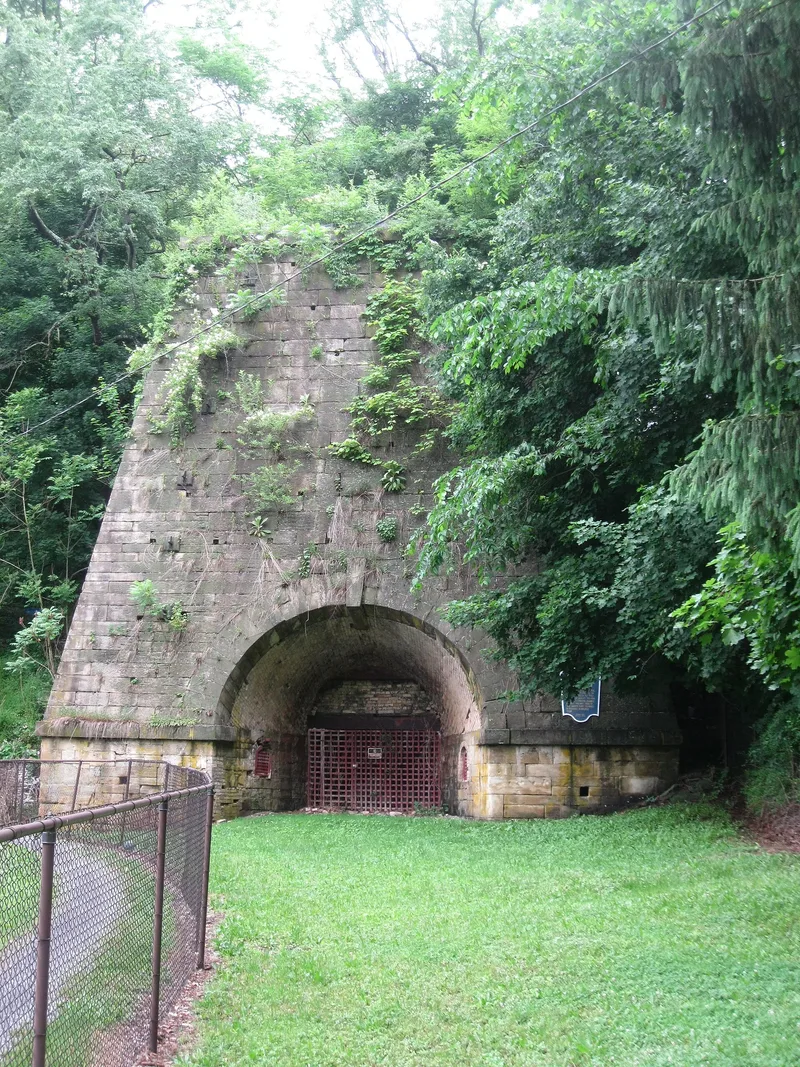
Built in 1836-1837 on the north bank of the West Branch of the Susquehanna River, this sandstone blast furnace rises 54 feet and stands 43 feet square at its base. Financed by Boston capitalists and probably supervised by Edward Thomas, a Welsh immigrant, it was built from stone quarried on the mountain behind the site. Its masonry is close fitted with very narrow joints, and the bosh is lined with refractory brick. The furnace is considered one of the earliest American efforts to pair coke fuel with hot blast, a method brought from Scotland by James Ralston in 1837. At completion it was among the largest blast furnaces in the country, with a stated capacity of 50 tons per week. Ore supply and transport costs proved unworkable, and the furnace closed in 1838. Its later use included a refractory brick works.
Significance in brief: The nomination argues the furnace is a rare surviving example of an early American attempt to combine coke fuel with hot blast technology in iron smelting. It also cites the quality of its close-fitted stone masonry and its size at the time of completion as significant engineering features.
Machine-generated summary. This summary was generated by a language model from the official nomination document and has not been reviewed line by line by an editor. It may contain errors. Check the source document before relying on any detail. Source: nomination document (PDF) · National Archives catalog entry. NRHP reference 91001137, listed September 6, 1991. Summary generated October 2026 (model claude-haiku-5-5, prompt v1.1-2026-10-29, confidence high).
Key facts
| Address | Jct. of Graham and Old Carrier Rds., Colebrook Township, Farrandsville |
|---|---|
| County | Clinton County |
| Listed | September 6, 1991 |
| Reference number | 91001137 |
| Resource type | Structure |
| Period of significance | 1836-1838 |
| Criteria |
|
| Areas of significance | Industry, Engineering |
| Level of significance | State |
| Status (as stated in the nomination) | The furnace closed in 1838 and there is no substantiated record of it being returned to blast; later it was part of a brickworks and was deeded to the Clinton County Historical Society in 1951. |
| Acreage | 0.1 |
| Coordinates | 41.17489, -77.51411 (NPS GIS) |
What listing means for this property
National Register listing is honorary: it recognises significance and does not restrict what a private owner may do without federal money or permits. It unlocks the 20% federal rehabilitation tax credit for income-producing buildings, state credits in many states, and Section 106 review when federal agencies are involved. See what listing means in practice.
General information, not legal or tax advice. Rules change; confirm with your State Historic Preservation Office or a qualified adviser.
Sources and further reading
- National Park Service, National Register of Historic Places database (snapshot May 2026), reference 91001137.
- Nomination form (PDF, National Archives) — catalog entry
- Wikipedia article (used for cross-checking only; text not reproduced here)
- Wikidata Q5436237
- This listing as JSON
Last updated October 2026. Found an error? See the editorial policy for how to report it.