Coalport Historic District

Why it's listed
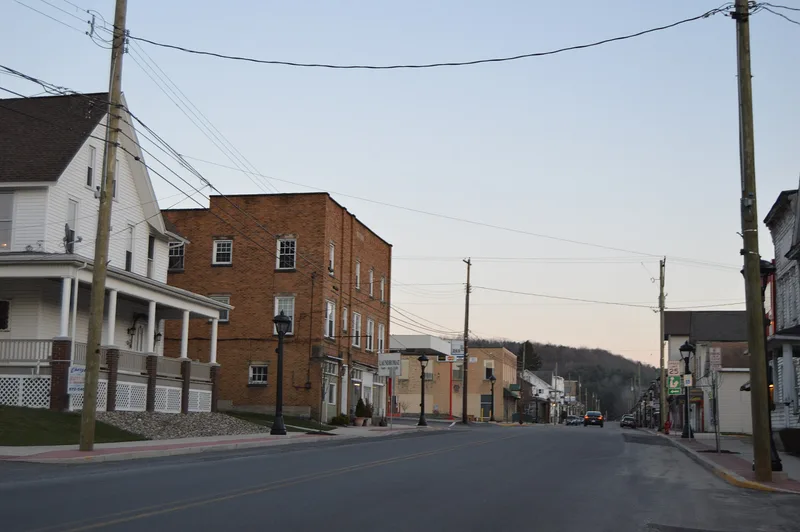
Coalport's Main Street historic district is a compact commercial area in a valley of southern Clearfield County, beside Clearfield Creek. Its 53 resources, mostly built between the 1860s and the 1940s, include storefronts, residences, a bank and churches in styles ranging from Italianate to Romanesque Revival. The town grew after James Haines began selling lots in 1877 and was incorporated as a borough in 1883, following the arrival of the Pennsylvania & Northwestern Railroad. Coal mining, including early small family mines and larger operations from 1887, supported the population and its shops. Because the town was not developed by a coal company, its businesses and houses were laid out without a single plan, and local merchants served miners and farmers alike. The district is regarded as a well-preserved example of a small boomtown business center in the region, where several original wooden buildings survive.
Significance in brief: The district is significant under Criterion A for commerce and Criterion C for architecture. It contains a small business area representative of towns of similar size in the region, and its late nineteenth and early twentieth century buildings reflect Coalport's development from coal and lumber activity. The nomination also notes that Coalport was not a company town, which gave its commercial and architectural development a diverse character.
Machine-generated summary. This summary was generated by a language model from the official nomination document and has not been reviewed line by line by an editor. It may contain errors. Check the source document before relying on any detail. Source: nomination document (PDF) · National Archives catalog entry. NRHP reference 99000517, listed April 29, 1999. Summary generated October 2026 (model claude-haiku-5-5, prompt v1.1-2026-10-29, confidence high).
Key facts
| Address | Along Main St., roughly form Mill to Walnut STs., Coalport |
|---|---|
| County | Clearfield County |
| Listed | April 29, 1999 |
| Reference number | 99000517 |
| Resource type | District |
| Period of significance | 1869-1946 |
| Architectural style | Colonial Revival, Queen Anne, Italianate, Gothic Revival, Second Empire, Romanesque |
| Criteria |
|
| Areas of significance | Commerce, Architecture |
| Level of significance | Local |
| Status (as stated in the nomination) | The district's resources are described as in fair condition, with many altered by vinyl or aluminum siding and window changes; thirteen of sixteen remaining Main Street businesses are within the district. |
| Acreage | 15 |
| Coordinates | 40.74644, -78.53573 (NPS GIS) |
What listing means for this property
This is a historic district. Buildings within its boundary are either contributing (they add to the district's significance) or non-contributing. Owners of contributing income-producing buildings can claim the 20% federal rehabilitation tax credit; homeowners should look at state credits. National Register districts impose no design review by themselves; a local historic district ordinance, if one exists, does (the difference explained).
General information, not legal or tax advice. Rules change; confirm with your State Historic Preservation Office or a qualified adviser.
Sources and further reading
- National Park Service, National Register of Historic Places database (snapshot May 2026), reference 99000517.
- Nomination form (PDF, National Archives) — catalog entry
- Wikipedia article (used for cross-checking only; text not reproduced here)
- Wikidata Q5138021
- This listing as JSON
Last updated October 2026. Found an error? See the editorial policy for how to report it.