Hammerstein, Oscar, II, Farm
Also known as: Highland Farm

Why it's listed
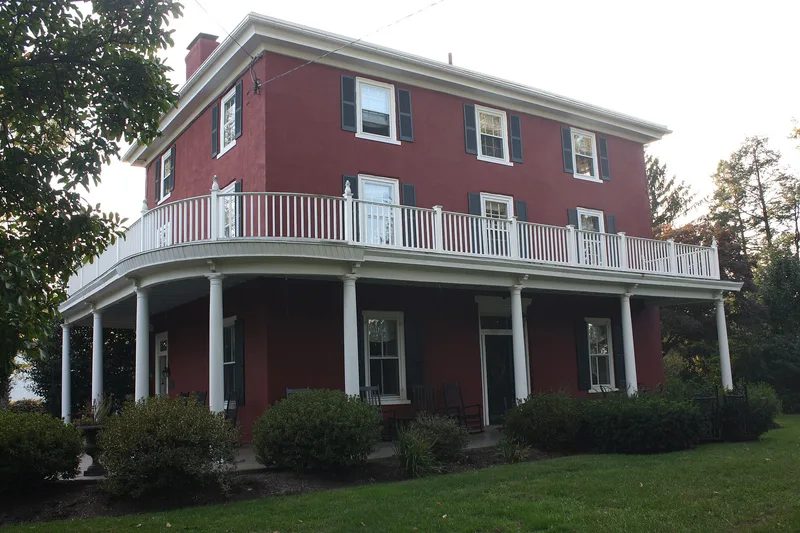
Set on a rise on the edge of Doylestown in Bucks County, Highland Farm is a group of mid-nineteenth century buildings that includes a three-story stuccoed masonry farmhouse, a frame bank barn and a frame carriage house. Wilson Malone most likely built the house, barn and carriage house during his ownership, which lasted until 1872. In 1940 Oscar Hammerstein II and his wife Dorothy bought the farm, which had been subdivided from a larger property in 1848. Hammerstein made it his primary residence and wrote most of his Broadway work there for the next twenty years, including the lyrics for Oklahoma!, whose opening song drew on his experiences at the farm. He died at the farm on August 23, 1960. The property is significant for its association with his writing career and for the changes the Hammersteins made to the house during their ownership, including the porch balustrade, fireplace surrounds and interior partition removal.
Significance in brief: The nomination argues the property is of national significance in the performing arts because Hammerstein wrote most of his Broadway works there while living on the farm from 1940 until his death in 1960. It is linked to musicals such as Oklahoma!, which was partly inspired by experiences at the farm, and the document presents the farm as the most significant property associated with him.
Machine-generated summary. This summary was generated by a language model from the official nomination document and has not been reviewed line by line by an editor. It may contain errors. Check the source document before relying on any detail. Source: nomination document (PDF) · National Archives catalog entry. NRHP reference 88002374, listed November 17, 1988. Summary generated October 2026 (model claude-haiku-5-5, prompt v1.1-2026-10-29, confidence medium).
Key facts
| Address | 70 East Rd., Doylestown |
|---|---|
| County | Bucks County |
| Listed | November 17, 1988 |
| Reference number | 88002374 |
| Resource type | Building |
| Period of significance | 1940-1960 |
| Criteria |
|
| Areas of significance | Performing Arts |
| Level of significance | National |
| Acreage | 4.9 |
| Coordinates | 40.30992, -75.11212 (NPS GIS) |
What listing means for this property
National Register listing is honorary for a privately owned home: it does not by itself restrict what an owner may do with their own money, and it does not require public access. Restrictions come from local landmark or historic-district ordinances, which are separate (how they differ).
Owner-occupied houses are not eligible for the 20% federal rehabilitation tax credit, which applies to income-producing buildings, but many states offer credits for homeowners. Listing also opens the door to preservation easements and to buying a plaque. Start with what listing means for homeowners, renovating a listed house and selling one.
General information, not legal or tax advice. Rules change; confirm with your State Historic Preservation Office or a qualified adviser.
Sources and further reading
- National Park Service, National Register of Historic Places database (snapshot May 2026), reference 88002374.
- Nomination form (PDF, National Archives) — catalog entry
- Wikipedia article (used for cross-checking only; text not reproduced here)
- Wikidata Q7106028
- This listing as JSON
Last updated October 2026. Found an error? See the editorial policy for how to report it.