Dyerstown Historic District

Why it's listed
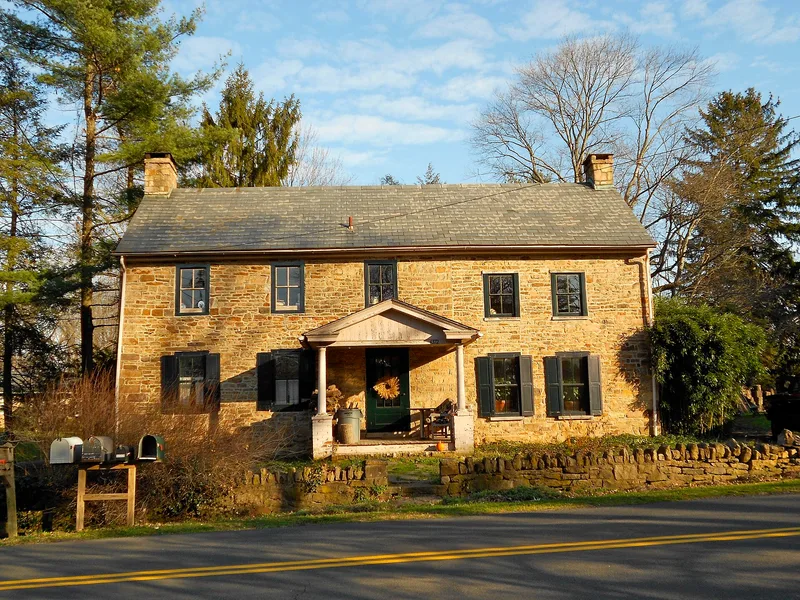
Dyerstown is a clustered stone hamlet of about eight residences, a former grist mill and several barns along Old Easton Road in Plumstead Township, Bucks County. Most of its houses were built between 1800 and 1850 from local stone, two and a half stories high with even window spacing and consistent street setbacks. The village grew around a grist mill first recorded in the early eighteenth century, and the 1798 tax list records a mill and several small stone houses. John Dyer III built a house in 1837 and another in 1843, and members of the Dyer family owned nearly all of the village into the 1850s. Dyerstown was bypassed by a newer highway in the 1940s, so its narrow road, stone walls and hedgerows remain. Its nineteenth century development ceased by the late 1800s, which keeps the village largely as it looked then. The district is regarded as an unusually well-preserved example of a Pennsylvania rural village of this period.
Significance in brief: The district is argued to be significant in architecture as an unusually intact assemblage of nineteenth century stone houses and a well-preserved rural village setting. Its buildings are largely vernacular Georgian and Federal in style, and the village was bypassed by later road development, which kept its historic appearance. Its growth was tied to the Dyer family, who owned nearly all of the village for much of the nineteenth century.
Machine-generated summary. This summary was generated by a language model from the official nomination document and has not been reviewed line by line by an editor. It may contain errors. Check the source document before relying on any detail. Source: nomination document (PDF) · National Archives catalog entry. NRHP reference 86003574, listed January 15, 1987. Summary generated October 2026 (model claude-haiku-5-5, prompt v1.1-2026-10-29, confidence high).
Key facts
| Address | Along Old Easton Rd. near jct. of Stony Ln., Plumstead Township |
|---|---|
| County | Bucks County |
| Listed | January 15, 1987 |
| Reference number | 86003574 |
| Resource type | District |
| Period of significance | 1798-1870 |
| Architectural style | Vernacular Colonial, with some Federal and Victorian adaptations |
| Criteria |
|
| Areas of significance | Architecture |
| Level of significance | Local |
| Status (as stated in the nomination) | Excellent condition with excellent integrity; the mill operated as a restaurant from the early twentieth century and one outbuilding is a garage. |
| Acreage | 19 |
| Coordinates | 40.34054, -75.12574 (NPS GIS) |
What listing means for this property
This is a historic district. Buildings within its boundary are either contributing (they add to the district's significance) or non-contributing. Owners of contributing income-producing buildings can claim the 20% federal rehabilitation tax credit; homeowners should look at state credits. National Register districts impose no design review by themselves; a local historic district ordinance, if one exists, does (the difference explained).
General information, not legal or tax advice. Rules change; confirm with your State Historic Preservation Office or a qualified adviser.
Sources and further reading
- National Park Service, National Register of Historic Places database (snapshot May 2026), reference 86003574.
- Nomination form (PDF, National Archives) — catalog entry
- Wikipedia article (used for cross-checking only; text not reproduced here)
- Wikidata Q5318581
- This listing as JSON
Last updated October 2026. Found an error? See the editorial policy for how to report it.