Durham Mill and Furnace

Approximate location: the National Park Service places this pin arbitrarily within the property, not at a surveyed point (stated accuracy ±12 m).
Why it's listed
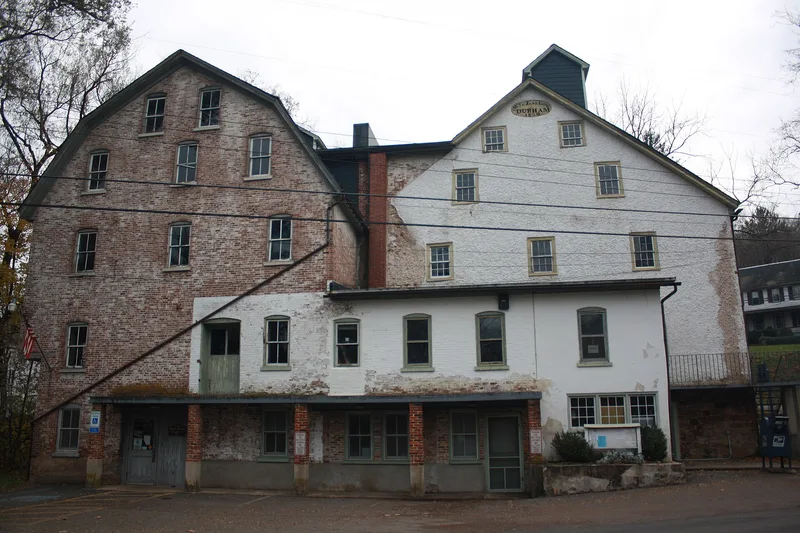
Durham Mill is a three-story stone grist mill in Durham, Bucks County, Pennsylvania, built in 1820 on the foundation walls of the Durham Furnace, an iron works dating from 1727. The mill follows the layout of a standard early nineteenth-century eastern Pennsylvania grist mill, with an overshot waterwheel fed by a three-quarter-mile raceway from Cook's Creek. The furnace produced pig and bar iron, cast iron wares, and during the Revolution, cannon, shot and other equipment for colonial troops. Durham boats built in the area were used in Washington's crossing of the Delaware. Rubin Knecht Bachman, a U.S. Representative, owned the mill in the late nineteenth and early twentieth centuries and added a brick warehouse in 1912. The mill operated continuously until 1967, mainly producing livestock feed. The county now owns it and is restoring the exterior.
Significance in brief: The nomination argues the mill is typical of early nineteenth-century grist mills in eastern Pennsylvania and that it stands on the site of an 18th-century iron furnace linked to the Revolutionary War. It also cites associations with signer George Taylor, General Daniel Morgan, and the Durham boats, and its operation as a mill until 1967.
Machine-generated summary. This summary was generated by a language model from the official nomination document and has not been reviewed line by line by an editor. It may contain errors. Check the source document before relying on any detail. Source: nomination document (PDF) · National Archives catalog entry. NRHP reference 76001608, listed November 21, 1976. Summary generated October 2026 (model claude-haiku-5-5, prompt v1.1-2026-10-29, confidence medium).
Key facts
| Address | Durham Rd., Durham |
|---|---|
| County | Bucks County |
| Listed | November 21, 1976 |
| Reference number | 76001608 |
| Resource type | Building |
| Period of significance | 1820-1967 |
| Architectural style | Vernacular |
| Criteria |
|
| Areas of significance | Industry, Agriculture, Commerce |
| Level of significance | State |
| Status (as stated in the nomination) | Exterior restoration under way; interior restoration and future operation as a living history museum are planned; open to the public May through October. |
| Acreage | 3.5 |
| Coordinates | 40.57643, -75.22375 (NPS GIS) |
What listing means for this property
For an income-producing building, listing (individually or as a contributing building in a district) is the gateway to the 20% federal rehabilitation tax credit on qualified rehabilitation costs, often stackable with state credits. Work claiming the credit must follow the Secretary of the Interior's Standards and be approved in advance.
Listing does not restrict a private owner acting without federal money or permits; where federal funding or licensing is involved, Section 106 review applies.
General information, not legal or tax advice. Rules change; confirm with your State Historic Preservation Office or a qualified adviser.
Sources and further reading
- National Park Service, National Register of Historic Places database (snapshot May 2026), reference 76001608.
- Nomination form (PDF, National Archives) — catalog entry
- Wikipedia article (used for cross-checking only; text not reproduced here)
- Wikidata Q5316533
- This listing as JSON
Last updated October 2026. Found an error? See the editorial policy for how to report it.