Williamsburg Historic District

Why it's listed
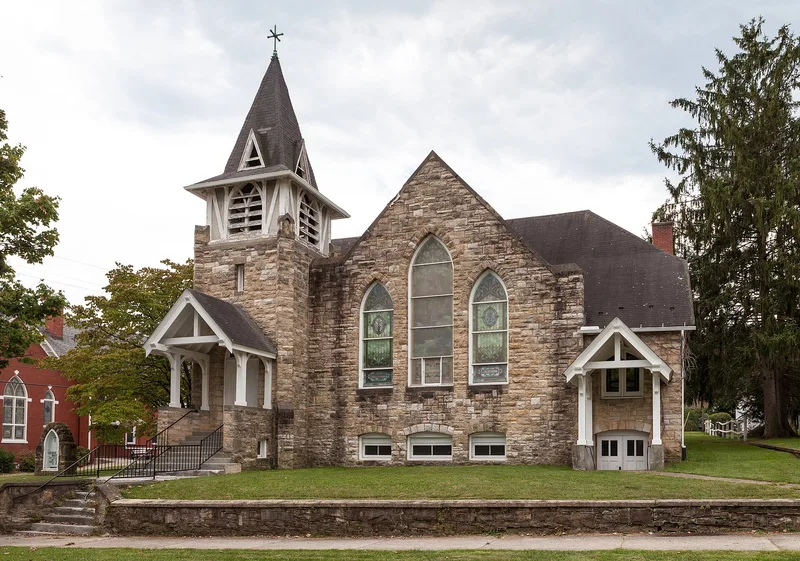
Williamsburg is a borough in east-central Blair County, Pennsylvania, laid out around 1795 by Jacob Ake on a grid with a central diamond-shaped square at High and First Streets. Its historic district holds 436 properties, most of them houses, with a commercial core along High Street. The town grew in three phases: during the canal era after 1832, when the Pennsylvania Main Line Canal carried iron, farm goods and limestone; during the railroad era after 1873; and during the paper mill era after 1905, when Charles M. Schwab helped establish a mill that became the town's main employer. The district is listed for its range of central Pennsylvania house types, from log-built I-houses and Georgian types to late nineteenth-century Queen Anne and early twentieth-century bungalows, and for its commercial buildings. The Big Spring, a limestone spring that powered mills for much of the town's history, remains part of the district.
Significance in brief: The nomination argues that the district conveys the town's commercial and architectural development across three periods: the canal era, the railroad era, and the paper mill era. Its collection of houses, commercial buildings and vernacular construction methods, including log buildings under later siding, is presented as representative of central Pennsylvania town building from about 1800 to 1944. The Big Spring, which powered mills and later supplied water to a paper mill, is described as the reason the town was founded at this location.
Machine-generated summary. This summary was generated by a language model from the official nomination document and has not been reviewed line by line by an editor. It may contain errors. Check the source document before relying on any detail. Source: nomination document (PDF) · National Archives catalog entry. NRHP reference 95000518, listed May 12, 1995. Summary generated October 2026 (model claude-haiku-5-5, prompt v1.1-2026-10-29, confidence medium).
Key facts
| Address | Approximately 30 square blocks centered around Second and High Sts., Williamsburg |
|---|---|
| County | Blair County |
| Listed | May 12, 1995 |
| Reference number | 95000518 |
| Resource type | District |
| Period of significance | C. 1800-1944 |
| Architect / builder | Rhule, David S. |
| Architectural style | Federal; Queen Anne; Gothic Revival; Bungalow; Georgian types; I-house; four square; gable front |
| Criteria |
|
| Areas of significance | Commerce, Architecture |
| Level of significance | Local |
| Status (as stated in the nomination) | The paper mill complex closed in 1974 and its buildings were demolished in 1979-80; the former Schwab Hotel now contains apartments. |
| Acreage | 160 |
| Coordinates | 40.45843, -78.20098 (NPS GIS) |
What listing means for this property
This is a historic district. Buildings within its boundary are either contributing (they add to the district's significance) or non-contributing. Owners of contributing income-producing buildings can claim the 20% federal rehabilitation tax credit; homeowners should look at state credits. National Register districts impose no design review by themselves; a local historic district ordinance, if one exists, does (the difference explained).
General information, not legal or tax advice. Rules change; confirm with your State Historic Preservation Office or a qualified adviser.
Sources and further reading
- National Park Service, National Register of Historic Places database (snapshot May 2026), reference 95000518.
- Nomination form (PDF, National Archives) — catalog entry
- Wikipedia article (used for cross-checking only; text not reproduced here)
- Wikidata Q8021168
- This listing as JSON
Last updated October 2026. Found an error? See the editorial policy for how to report it.