Schellsburg Historic District

Why it's listed
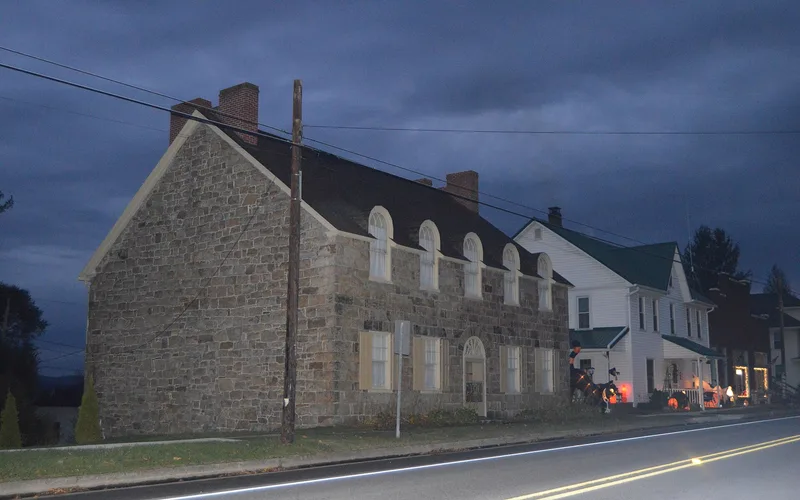
Schellsburg is a crossroads village in central-western Bedford County whose historic core lies along Pitt Street (U.S. 30) and Market Street. The village was founded by John Schell, who laid out the town in 1808 along the Bedford-Stoystown Turnpike. Its brick and stone buildings, many in the Federal style, cluster along three blocks of Pitt Street and date largely from the early nineteenth century, including the Schell-Colvin Building of about 1810 and the Clarke House of 1810. Mixed residential and commercial buildings, churches, a Odd Fellows lodge built in 1876, and modest vernacular houses fill the surrounding streets. The village served travelers on the turnpike and, after 1913, the Lincoln Highway, supporting inns, garages and shops. Its commercial role continued after the railroad bypassed it in the 1850s. The district is valued for how completely its early buildings and small-town commercial pattern have survived.
Significance in brief: The district is significant under Criterion A for commerce and transportation as a small business centre serving highway travelers and the surrounding agricultural area, linked to the Lincoln Highway. It is also significant under Criterion C for its unusually intact collection of Federal style masonry buildings from the first half of the nineteenth century and well-preserved vernacular dwellings from the late nineteenth and early twentieth centuries.
Machine-generated summary. This summary was generated by a language model from the official nomination document and has not been reviewed line by line by an editor. It may contain errors. Check the source document before relying on any detail. Source: nomination document (PDF) · National Archives catalog entry. NRHP reference 01000677, listed June 21, 2001. Summary generated October 2026 (model claude-haiku-5-5, prompt v1.1-2026-10-29, confidence medium).
Key facts
| Address | Approx. centered on Pitt St., Market and Baltimore Sts., Schellsburg Borough |
|---|---|
| County | Bedford County |
| Listed | June 21, 2001 |
| Reference number | 01000677 |
| Resource type | District |
| Period of significance | 1808-1940 |
| Architectural style | Federal; Second Empire; Four Square; Prairie School; Dutch Colonial Revival; vernacular |
| Criteria |
|
| Areas of significance | Commerce, Transportation, Architecture |
| Level of significance | Local |
| Status (as stated in the nomination) | Overall integrity is described as high; noncontributing resources are mostly altered and newer residential buildings. Several historic commercial buildings remain in use, including antique shops and auto repair garages. |
| Acreage | 46 |
| Coordinates | 40.04585, -78.64284 (NPS GIS) |
What listing means for this property
This is a historic district. Buildings within its boundary are either contributing (they add to the district's significance) or non-contributing. Owners of contributing income-producing buildings can claim the 20% federal rehabilitation tax credit; homeowners should look at state credits. National Register districts impose no design review by themselves; a local historic district ordinance, if one exists, does (the difference explained).
General information, not legal or tax advice. Rules change; confirm with your State Historic Preservation Office or a qualified adviser.
Sources and further reading
- National Park Service, National Register of Historic Places database (snapshot May 2026), reference 01000677.
- Nomination form (PDF, National Archives) — catalog entry
- Wikipedia article (used for cross-checking only; text not reproduced here)
- Wikidata Q7431112
- This listing as JSON
Last updated October 2026. Found an error? See the editorial policy for how to report it.