Armstrong Farm
Also known as: Reber Farm

Why it's listed
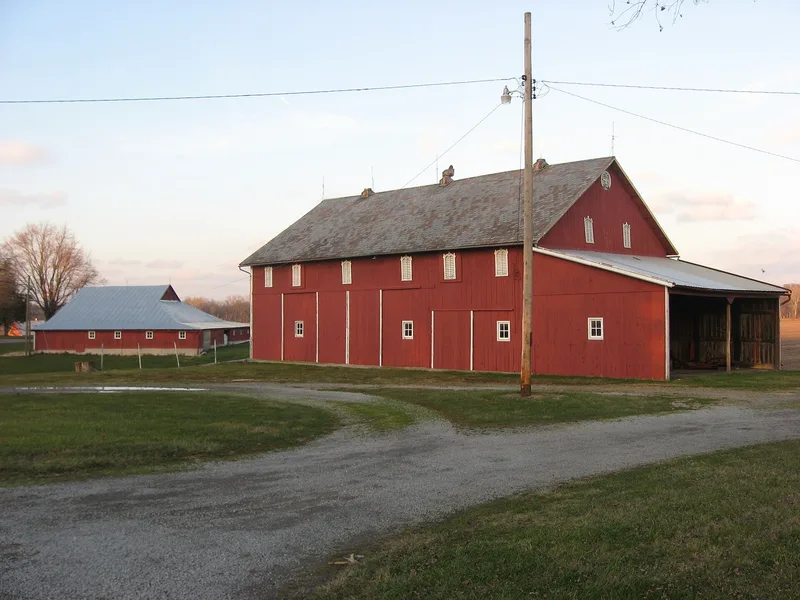
Armstrong Farm is a working farm of roughly 537 acres on S.R. 199 south of Upper Sandusky, Ohio. Its core is a two-story painted brick farmhouse built in 1830 by Silas Armstrong, with Doric porch columns, a summer kitchen combining smokehouse and bake oven, four large barns, and a tenant house. The land was part of the Wyandot Reservation and was granted to Robert Armstrong, who had been captured by the Wyandots as a child, under the 1817 Treaty of the Rapids. Silas moved west with the Wyandot in 1843. Thomas V. Reber then bought the tract, and the Reber family expanded the holdings and farmed them for generations. The house was identified in a survey as the only extant brick house on the former reservation and the oldest brick house in the county. The farm was listed for its Wyandot connections, its farming history, and its vernacular architecture. The Keeper noted that the twentieth-century buildings were not shown to be significant.
Significance in brief: The nomination argues that the farm is tied to the Wyandot occupation of the area and to the Armstrong and Reber families, and that it is an example of a profitable farming operation from the mid-nineteenth century onward. The 1830 brick farmhouse is described as a representative example of vernacular brick building and as the oldest brick house in the county. The land is largely the tract granted to Robert Armstrong by the 1817 Treaty of the Rapids.
Machine-generated summary. This summary was generated by a language model from the official nomination document and has not been reviewed line by line by an editor. It may contain errors. Check the source document before relying on any detail. Source: nomination document (PDF) · National Archives catalog entry. NRHP reference 86000070, listed January 17, 1986. Summary generated October 2026 (model claude-sonnet-5-5, prompt v1.0-2026-10-29, confidence high).
Key facts
| Address | 13706 OH 199, Upper Sandusky |
|---|---|
| County | Wyandot County |
| Listed | January 17, 1986 |
| Reference number | 86000070 |
| Resource type | Building |
| Period of significance | 1800-1899 |
| Architect / builder | Builder/architect unknown (main house built by Silas Armstrong in 1830) |
| Architectural style | Vernacular (brick vernacular farmhouse with restrained classical details) |
| Criteria |
|
| Areas of significance | Agriculture, Exploration/Settlement, Architecture |
| Level of significance | Local |
| Status (as stated in the nomination) | Main farmhouse in excellent condition and occupied; the land is farmed by a tenant farmer. |
| Acreage | 536.8 |
| Coordinates | 40.79787, -83.27364 (NPS GIS) |
What listing means for this property
National Register listing is honorary for a privately owned home: it does not by itself restrict what an owner may do with their own money, and it does not require public access. Restrictions come from local landmark or historic-district ordinances, which are separate (how they differ).
Owner-occupied houses are not eligible for the 20% federal rehabilitation tax credit, which applies to income-producing buildings, but many states offer credits for homeowners. Listing also opens the door to preservation easements and to buying a plaque. Start with what listing means for homeowners, renovating a listed house and selling one.
General information, not legal or tax advice. Rules change; confirm with your State Historic Preservation Office or a qualified adviser.
Sources and further reading
- National Park Service, National Register of Historic Places database (snapshot May 2026), reference 86000070.
- Nomination form (PDF, National Archives) — catalog entry
- Wikipedia article (used for cross-checking only; text not reproduced here)
- Wikidata Q4793940
- This listing as JSON
Last updated October 2026. Found an error? See the editorial policy for how to report it.