Stanford, George, Farm
Also known as: Hs-442; < Hs-442%a; Hs-442%b; Hs-443-446

Why it's listed
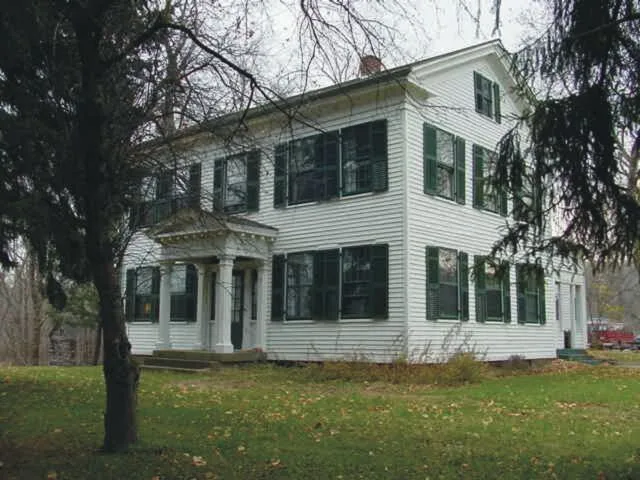
Set on Stanford Road just north of the village of Boston, this farmstead looks west toward the Cuyahoga River and the Ohio and Erie Canal. The centerpiece is a two-story Greek Revival house, probably built about 1830, with five bays, a central entrance porch with pediment, clapboard siding, and a rear ell. The house is described as essentially unchanged since it was pictured in an 1874 county atlas. Surviving outbuildings include a springhouse, barn, corn crib, and brick smoke house. James Stanford settled the land in 1806 after joining the party that surveyed Boston Township, and he reportedly suggested its name. His son George, who probably built the house, and grandson George C. both farmed here and served in township offices, including justice of the peace. The property is valued for this family association, its Greek Revival architecture, and its picture of nineteenth-century farming in the Cuyahoga Valley. It is now park land, and the buildings stand vacant.
Significance in brief: The nomination cites the property's long association with the Stanford family, prominent in Boston Township. James Stanford settled the land in 1806 and took part in surveying the township, and his son and grandson held township offices. The house is described as a fine example of Greek Revival architecture, and the farm illustrates the township's agricultural heritage.
Machine-generated summary. This summary was generated by a language model from the official nomination document and has not been reviewed line by line by an editor. It may contain errors. Check the source document before relying on any detail. Source: nomination document (PDF) · National Archives catalog entry. NRHP reference 82001874, listed February 17, 1982. Summary generated October 2026 (model claude-sonnet-5-5, prompt v1.0-2026-10-29, confidence medium).
Key facts
| Address | 6093 Stanford Rd., Peninsula |
|---|---|
| County | Summit County |
| Listed | February 17, 1982 |
| Reference number | 82001874 |
| Resource type | Building |
| Architectural style | Greek Revival |
| Areas of significance | Agriculture, Exploration/Settlement, Architecture |
| Level of significance | Local |
| Status (as stated in the nomination) | The house and outbuildings were described as vacant; the property was purchased by the National Park Service and is part of Cuyahoga Valley National Recreation Area. |
| Acreage | 3 |
| Coordinates | 41.27125, -81.55680 (NPS GIS) |
What listing means for this property
National Register listing is honorary for a privately owned home: it does not by itself restrict what an owner may do with their own money, and it does not require public access. Restrictions come from local landmark or historic-district ordinances, which are separate (how they differ).
Owner-occupied houses are not eligible for the 20% federal rehabilitation tax credit, which applies to income-producing buildings, but many states offer credits for homeowners. Listing also opens the door to preservation easements and to buying a plaque. Start with what listing means for homeowners, renovating a listed house and selling one.
Noted as vacant in the nomination. Nomination documents can be decades old; current status may differ. If you are considering buying an empty listed property, read the due-diligence checklist.
General information, not legal or tax advice. Rules change; confirm with your State Historic Preservation Office or a qualified adviser.
Sources and further reading
- National Park Service, National Register of Historic Places database (snapshot May 2026), reference 82001874.
- Nomination form (PDF, National Archives) — catalog entry
- Wikipedia article (used for cross-checking only; text not reproduced here)
- Wikidata Q100490221
- This listing as JSON
Last updated October 2026. Found an error? See the editorial policy for how to report it.