Freedom Congregational Church

Why it's listed
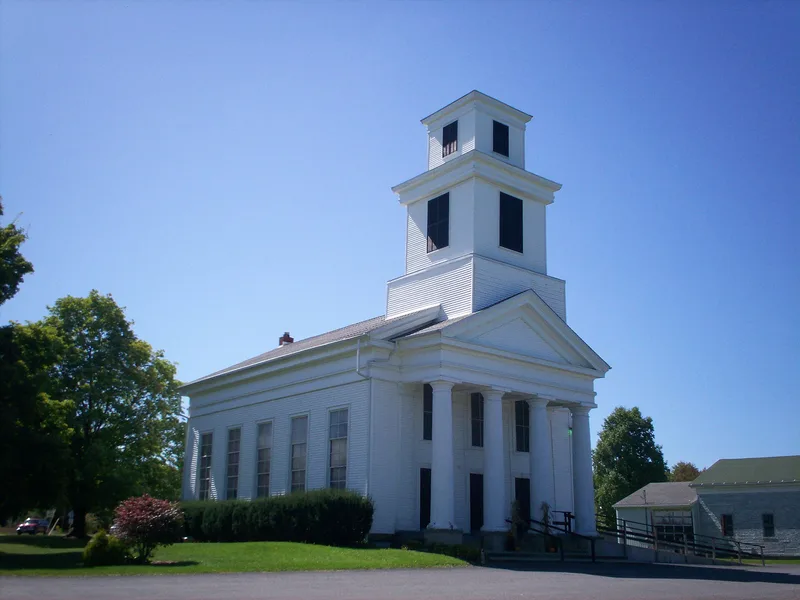
Freedom Congregational Church is a medium-sized wooden frame church built in 1845 at a cost of $3,000 on the public green in Freedom, Ohio. Its form follows a late Federal meetinghouse, but the proportions and details are the heavier ones of the Greek Revival. A four-column Tuscan portico with a prominent entablature and pediment projects from the north facade, and its columns are hollow cylinders made of vertical boards. The three-stage tower is placed unusually, straddling the roof and the portico rather than rising flush with the facade. The congregation was organized in 1828 by members of the Presbytery of Portage County, met first in a log cabin, and built a small frame church in 1835. The interior was remodeled in 1865, and a basement was added in the twentieth century. The church was listed because it is regarded as one of the half-dozen most important Greek Revival churches left in northeastern Ohio.
Significance in brief: The nomination argues its significance is primarily architectural. It is described as one of the half-dozen most important Greek Revival churches remaining in northeastern Ohio. Its fine four-column portico and the unusual placement of the tower over the portico make it especially notable.
Machine-generated summary. This summary was generated by a language model from the official nomination document and has not been reviewed line by line by an editor. It may contain errors. Check the source document before relying on any detail. Source: nomination document (PDF) · National Archives catalog entry. NRHP reference 75001521, listed July 7, 1975. Summary generated October 2026 (model claude-sonnet-5-5, prompt v1.0-2026-10-29, confidence high).
Key facts
| Address | Public Green on OH 88, Freedom |
|---|---|
| County | Portage County |
| Listed | July 7, 1975 |
| Reference number | 75001521 |
| Resource type | Building |
| Period of significance | 19th Century (specific date 1845) |
| Architectural style | Greek Revival |
| Areas of significance | Architecture |
| Level of significance | State |
| Status (as stated in the nomination) | Listed in good condition, altered, on its original site, and occupied; used for religious purposes. The interior was remodeled in 1865 and a basement was added in the twentieth century. |
| Acreage | 2 |
| Coordinates | 41.23521, -81.14695 (NPS GIS) |
What listing means for this property
Religious properties are listed for their architectural or historical significance, not their religious use. Listing is honorary and does not restrict the congregation's use of the building. The federal rehabilitation credit is generally unavailable unless part of the building is income-producing; some state programmes and preservation grants do cover religious buildings. Federal funding or permits trigger Section 106 review.
General information, not legal or tax advice. Rules change; confirm with your State Historic Preservation Office or a qualified adviser.
Sources and further reading
- National Park Service, National Register of Historic Places database (snapshot May 2026), reference 75001521.
- Nomination form (PDF, National Archives) — catalog entry
- Wikipedia article (used for cross-checking only; text not reproduced here)
- Wikidata Q5500510
- This listing as JSON
Last updated October 2026. Found an error? See the editorial policy for how to report it.